

Supplier of blowers and compressors: Simulation supports factory planning from the concept phase through to detailed planning
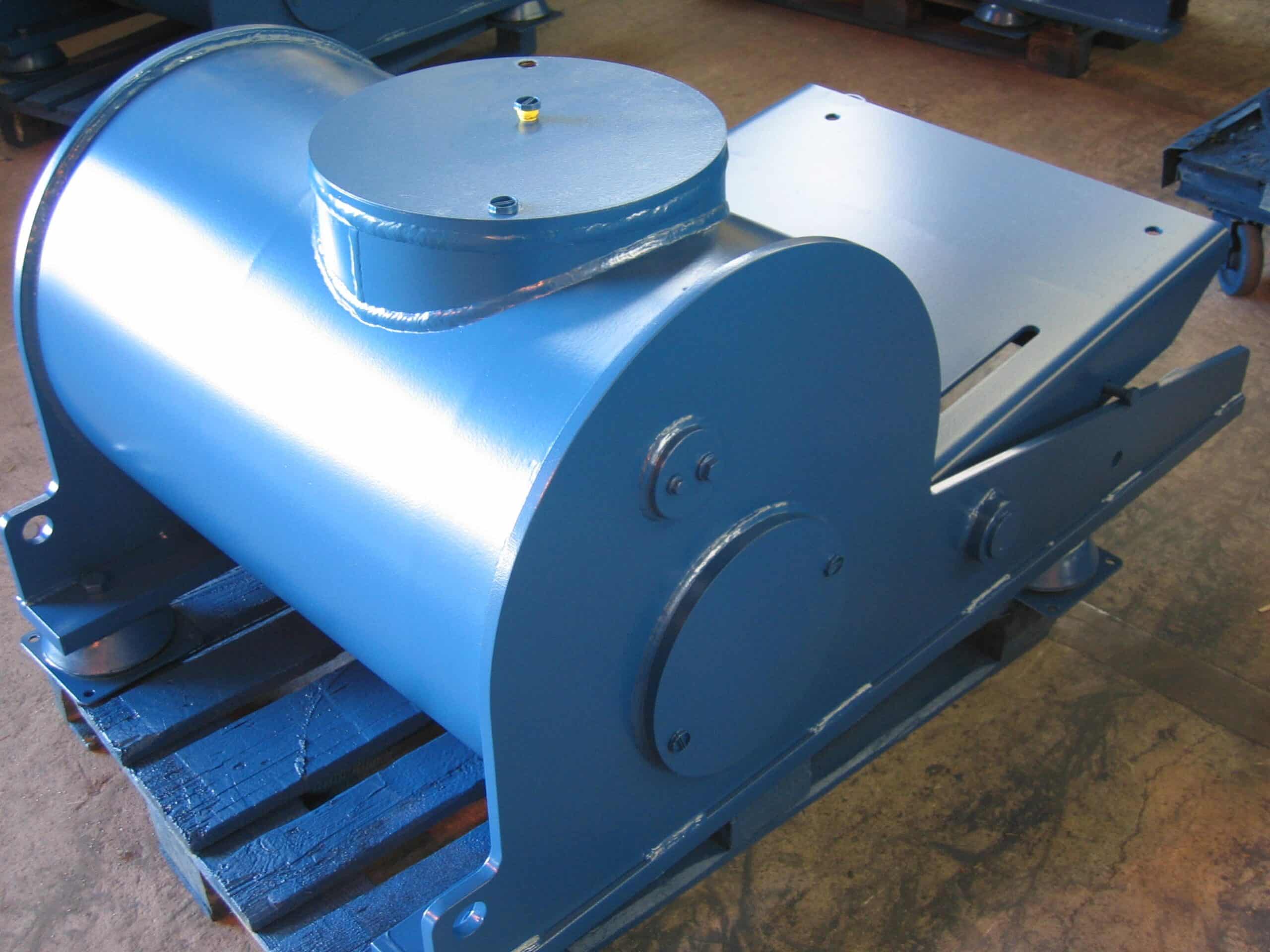
Emmerthaler Apparatebau GmbH (EmmApp), a medium-sized company based in Emmerthal near Hameln, manufactures, amongst other things, industrial silencers that customers install in blowers and compressors. The company employs around 145 staff and, as a wholly-owned subsidiary, is part of Aerzener Maschinenfabrik, for which it acts as a key supplier.
Initial situation: Demand is growing faster than capacity
Orders from Aerzener Maschinenfabrik increased significantly, meaning that EmmApp was reaching the limits of its existing production capacity. In addition, the group wanted to bring back capacity that had previously been sourced from Poland, as there had been repeated problems with suppliers there. Taken together, these two developments made it necessary to expand the plant in Emmerthal.
As early as 2006, the decision in principle was therefore taken to modernise the site. A project team comprising representatives from Aerzener Maschinenfabrik and EmmApp brought two specialist consultancies on board for this purpose, one of which was SimPlan.
Objective: Increased output without additional staff
The objective was clearly defined. Production capacity was to rise from around 3,000 to 8,000 units, whilst retaining the same number of employees as before. To ensure that the investment in new buildings and manufacturing technology would truly pay off, the simulation was also intended to clarify which factory layout would most effectively reduce costs.
Specifically, the planning was intended to answer the following questions:
- How many workstations, welding cells and staff does the new production facility actually require?
- Which control principle and which allocation of component variants to resources work best?
- What should the factory layout look like to ensure short distances and minimal waiting times?
- How many internal transport movements, such as forklift journeys, will the new layout generate, and what staffing requirements will this entail?
Solution: Simulation from rough planning to detailed planning
SimPlan supported the entire planning process from start to finish, from the initial concept to the detailed planning of the new hall. The approach deliberately followed what is known as ‘greenfield planning’. This means that the team first planned the production independently of the existing hall and only subsequently adapted it to the actual space constraints.
“Greenfield planning enabled us to tackle the whole project systematically,” said Dr. Sven Spieckermann, CEO of SimPlan AG.
The process began with an in-depth data analysis, as a robust simulation cannot be built without a reliable foundation. To this end, SimPlan collected and cleaned up order structures, processing times, set-up times, part master data and bills of materials.
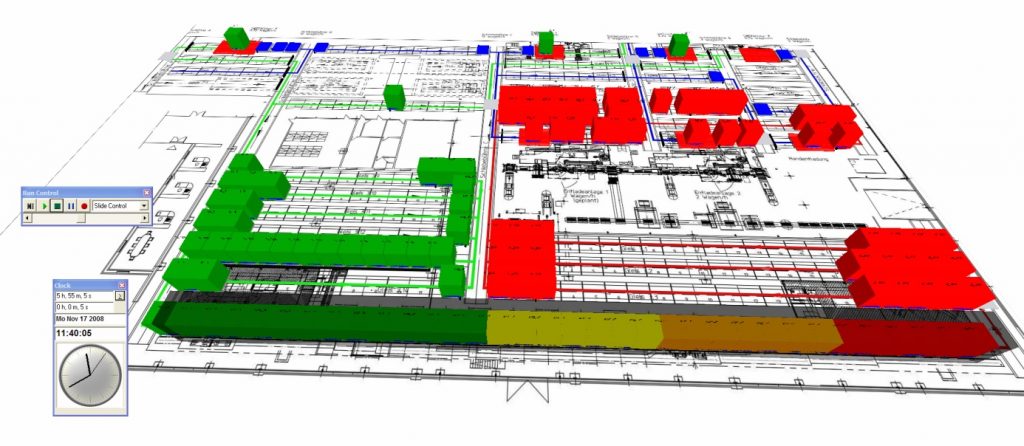
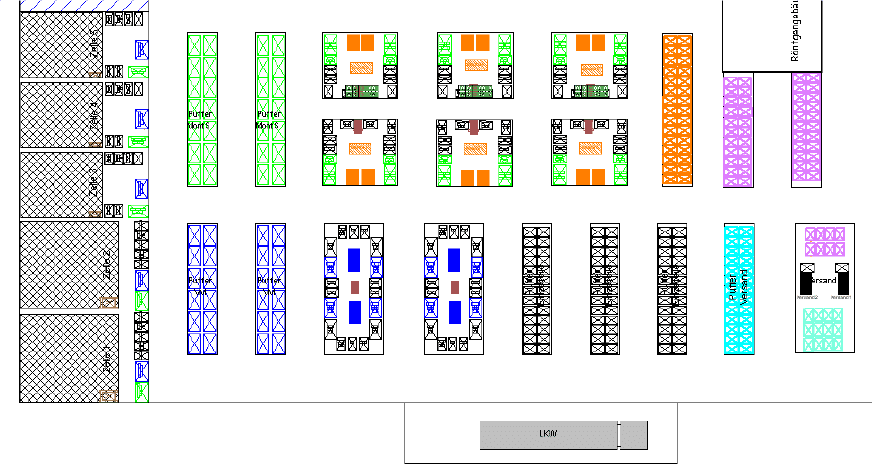
Several rough concepts were developed on this basis. These differed in terms of the number of resources allocated, the control principle and the assignment of component variants to workstations. SimPlan visualised the concepts as block layouts and subsequently evaluated them using simulation models based on output, resource utilisation, lead times and stock levels.
As the management were not yet satisfied with the initial results, the project team refined the planning once more. In doing so, they reorganised the production steps – from pre-assembly through the use of welding robots to final assembly – and recalculated the required workstations. This additional step ultimately led to a 20 per cent increase in productivity compared with the original concept.
SimPlan then transferred the results of the rough planning to the detailed and layout planning stages. To this end, the team developed, evaluated and compared several factory layouts via simulation, refining in particular the arrangement of buffers, workstations and welding cells. In addition, SimPlan determined the internal transport requirements, such as the necessary forklift journeys and the resulting staffing requirements.
The new extension was built directly adjacent to the existing hall in Kirchohsen. It measures 105 by 40 metres, comprises 5,200 square metres of usable floor space and offers 4,500 square metres of dedicated production space. In total, Aerzener Maschinenfabrik and EmmApp invested around 6 million euros, of which 4.5 million euros went towards the new building and 1.5 million euros towards manufacturing technology, primarily the welding robots.
Results: Higher output, shorter lead times and lower stock levels
The continuous use of simulation throughout the project paid off in several ways:
- EmmApp will be able to produce significantly more units in future, whilst maintaining the same number of staff as before
- The production resources are appropriately sized, as the preliminary planning determined the actual number of workstations, welding cells and staff required
- The new layout was gradually refined and underpinned by a clear production control concept
- Lead times are falling significantly, whilst stock levels are actually decreasing slightly despite higher production figures
- The intensive work with order and product data also revealed potential for streamlining the data sets
- As a further side effect, suggestions emerged for simplifying the design and development of the silencers
Simulation as a key to success for medium-sized suppliers too
The EmmApp example shows that simulation methods are not only worthwhile for large companies. Even a business with around 145 employees can use simulation to support its factory planning throughout the process and benefit from it, as this allows planning errors and misguided investments to be avoided even before construction begins.
Particularly when a capacity expansion coincides with the relocation of production and tight cost targets, simulation helps to objectively compare different concepts before real money is spent on concrete and plant. Therefore, the end-to-end approach from concept to detailed planning remains a sensible way for other medium-sized manufacturing companies to manage growth without unnecessary staff expansion.