

Construction supplier of precast concrete elements: Agent-based simulation for an automated production line
Herrenknecht Formwork was commissioned to design a new production concept for one of Europe’s largest construction projects. As space is limited and labour costs are high in Germany, the company opted for a continuous production line with a high degree of automation.
Initial situation: Lack of space and labour costs favour automation
In the plant, the concrete formwork passes through a fixed production line. It is stripped, cleaned, oiled, fitted with reinforcement, closed, concreted and given a surface finish. The formwork moves from one station to the next in a cyclical manner, similar to a flow production line in the automotive industry. Following these steps, they enter a curing oven, with the cycle time and available positions determining the dwell time.
Objective: To clarify complex cycle time and logistics issues in advance
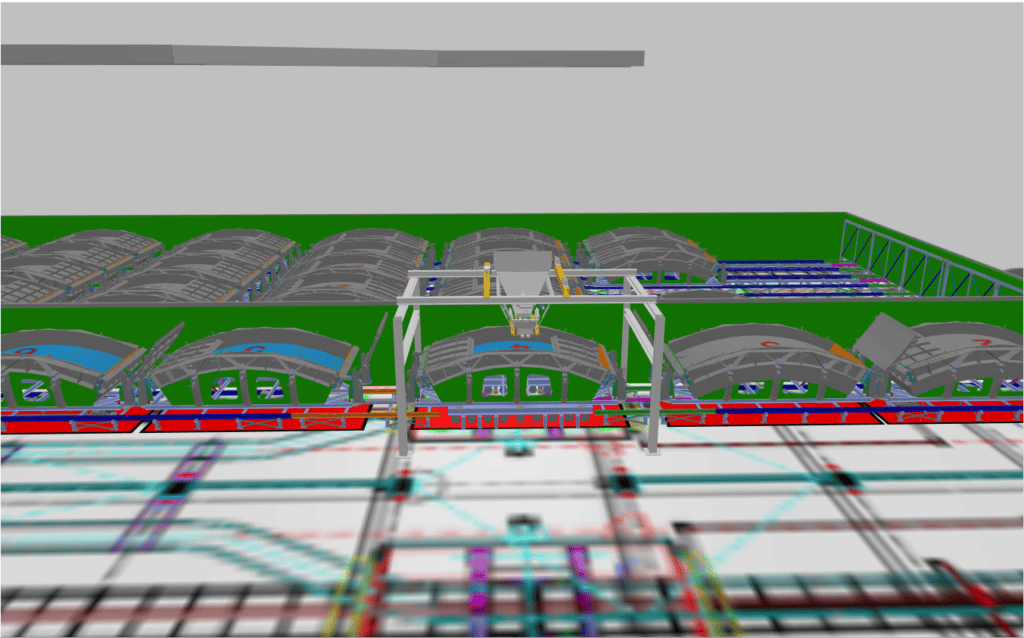
Herrenknecht had to ensure that the entire number of formworks could be filled and transferred to the curing process within a single shift. This significantly reduced the available cycle time at individual stations. Furthermore, for operational reasons, the concrete mixing plants were to be situated further away from the filling station, which meant longer transport routes for the concrete buckets. Each bucket had to make two trips per mould, and braking, acceleration and slow cornering all added to the time taken.
Because so many process steps and logistical interdependencies were involved, it was no longer possible to calculate the cycle time manually. Herrenknecht therefore commissioned SimPlan to simulate the entire process, realistically modelling all machines and systems with their individual motion sequences and speeds.
Solution: Agent-based simulation with AnyLogic and 3D visualisation
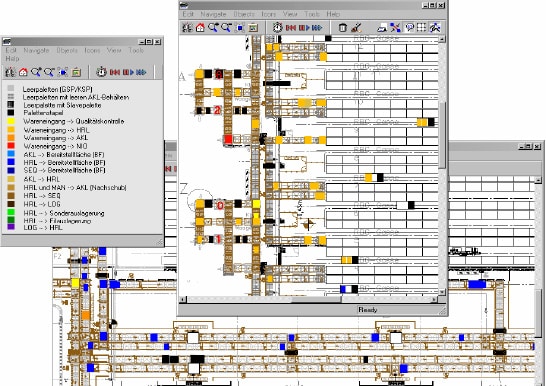
SimPlan used AnyLogic for the simulation because the software enables agent-based modelling whilst also offering flexible ways to share the finished model. A key advantage of this is that Herrenknecht and its customers can use the model free of charge, either as a standalone Java application or via the AnyLogic Cloud. This allows the customer to run and evaluate the simulation directly without installing any additional software.
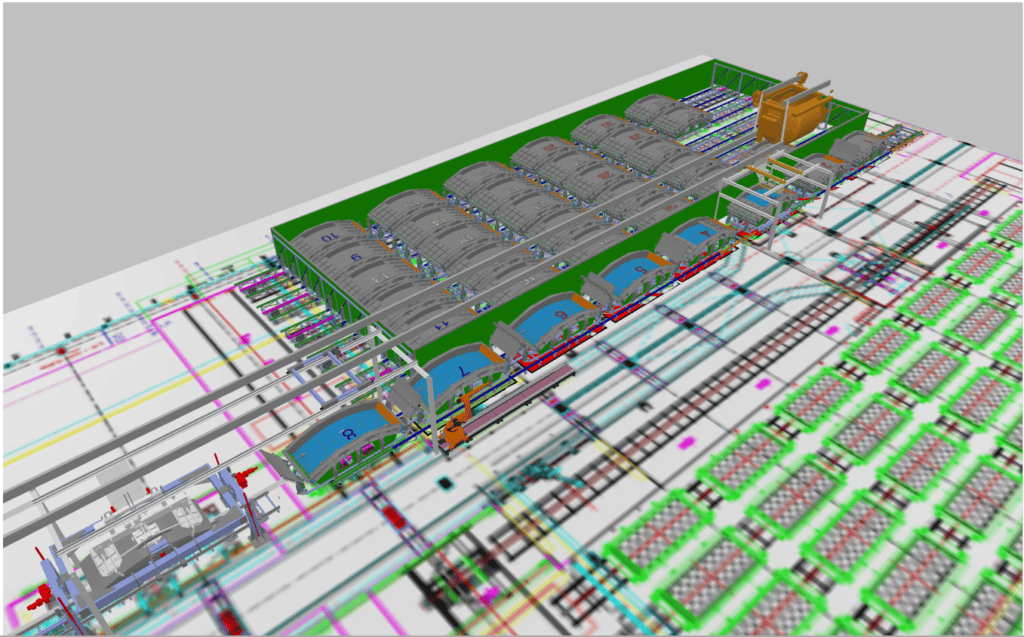
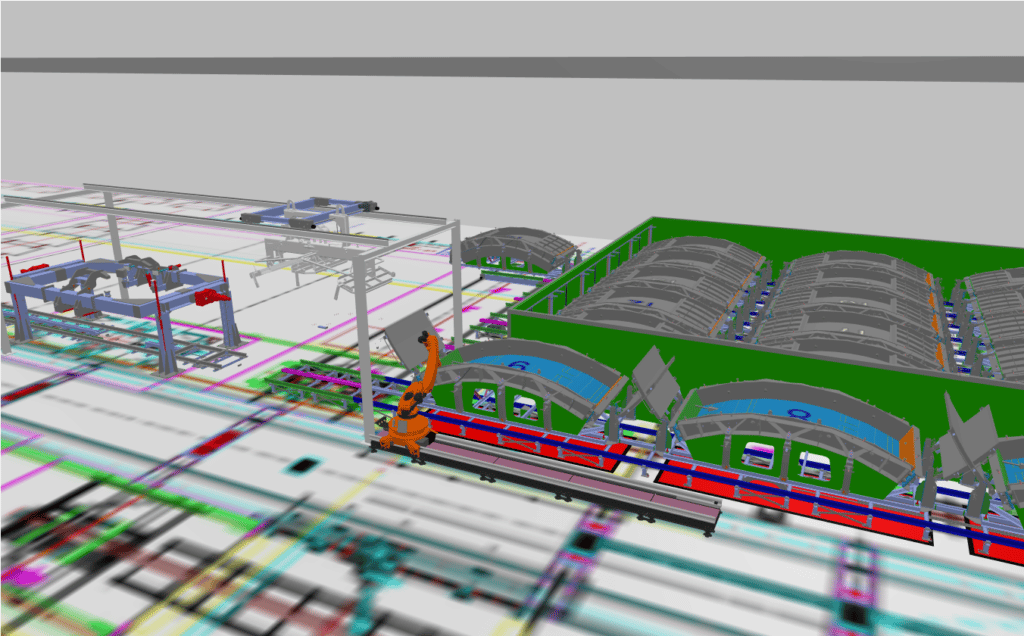
For client presentations, SimPlan also created a realistic 3D representation of the plant. Existing CAD models were imported into the simulation tool and adapted for this purpose. In addition to the movement of the formwork, SimPlan also animated the cleaning robot and the formwork covers, as the three-dimensional representation enhances the clarity of the presentation and helps to verify the process logic precisely.
To reduce staffing requirements, SimPlan incorporated various automation steps:
- The moulds open automatically as soon as they reach the demoulding position
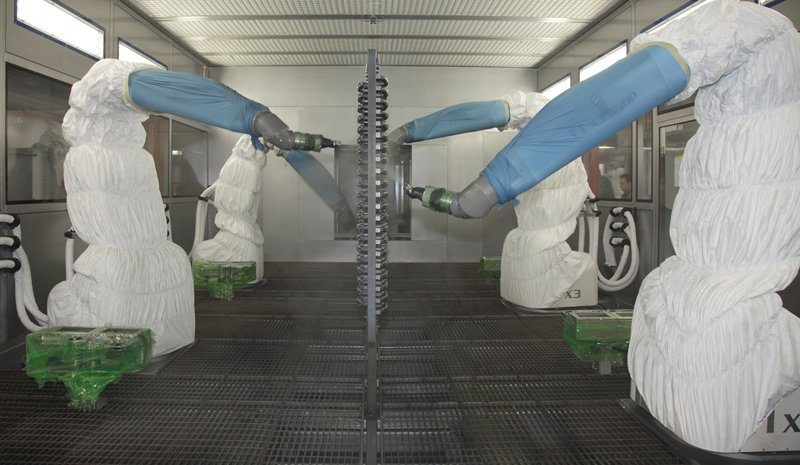
- A robot carries out the cleaning
- Closing and surface finishing are carried out semi- or fully automatically
In addition, the model took into account a second, mirrored continuous-flow line in an adjacent hall. However, this does not affect the cycle time of the first line.
Results: Feasibility and limitations of the plant made visible
The finished simulation model can be used flexibly, as users can enter cycle times and pause times themselves. The simulation showed that the planned plant delivers the intended output of precast concrete elements. At the same time, it highlighted where the limitations lie – that is, at which cycle times curing times or layer application times can no longer be met.
Simulation as a basis for decision-making prior to investment
In a project of this scale, it is virtually impossible to reliably estimate the economic viability of a new production line when numerous process steps, levels of automation and logistical interdependencies all interact simultaneously.
A simulation demonstrates, even before construction begins, whether a design achieves the required output and where it reaches its limits. This applies not only to continuous production lines in precast concrete manufacturing, but to any production line that operates with a high degree of automation and is subject to tight cycle time requirements. Knowing the load limits of one’s plant enables one to make more informed investment decisions and avoid the need for subsequent modifications.