


Rail logistics: Simulation assesses whether a new container terminal can handle the planned volumes
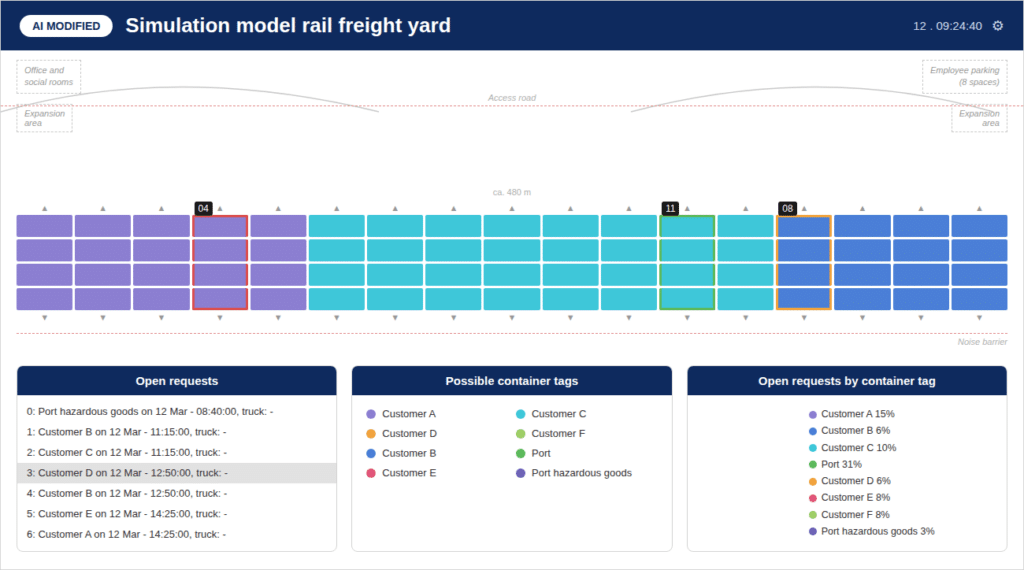
A rail freight operator was planning to build a new freight yard with a container terminal and transhipment hall. Before the facility was built, a simulation model was to determine whether the planned concept could meet the demands of day-to-day operations.
Initial situation: New terminal for transhipment between train and lorry
The planned freight yard was intended to handle the transhipment of containers between train and lorry. To this end, a transhipment hall was planned, in which requests from external plants would be processed and lorry traffic between the terminal and customers would take place. Prior to construction, there was uncertainty as to whether the concept could reliably handle the required volumes and what framework conditions would need to be met by customers.
Objective: Clarity on capacity and customer requirements
The focus was on two questions:
- Can the required volumes of material be successfully transhipped?
- What requirements must be placed on customers to ensure operations run smoothly?
Solution: Simulation of various operational strategies
SimPlan assessed the concepts for the new freight yard using a simulation model. Various operational strategies were run through the model and evaluated using key performance indicators, thereby revealing the weaknesses of each strategy. On this basis, specific requirements for customers were formulated and their impact tested within the model.
Results: A key performance indicator-based decision-making framework prior to construction
The simulation highlighted where individual operational strategies reached their limits, thereby providing a robust basis for planning. The resulting requirements for customers were tested in the model before being incorporated into the actual planning process.
Regarding the scope of the available material: The documents provided do not contain specific key performance indicators such as throughput, capacity utilisation or cost savings. The results section therefore deliberately remains at this general level. If you have further figures or details regarding the project, I would be happy to update this section.
Why it is worth planning transhipment points before construction
A freight yard with a container terminal is an investment that can hardly be adjusted over the course of decades. Misjudgements regarding the sizing of transhipment halls, lorry traffic or customer interfaces often only become apparent during ongoing operations, when making adjustments becomes significantly more expensive than during the planning phase. A simulation prior to construction highlights bottlenecks and weaknesses in various operational strategies before concrete is poured and tracks are laid. This applies not only to freight terminals, but to every interface in rail freight transport where different modes of transport and external partners converge.