

Tailored solutions for complex requirements
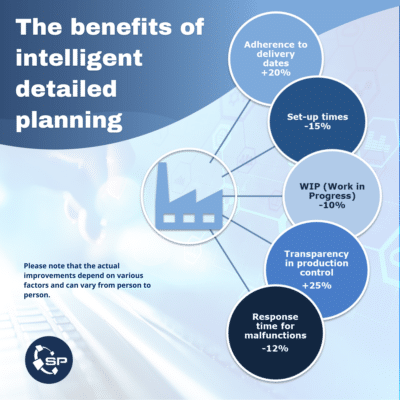
The manufacturing industry is under constant pressure to adapt: shorter lead times, smaller batch sizes and increasing complexity present companies with new challenges every day. Intelligent detailed planning helps to meet these requirements in a targeted and efficient manner – through software-supported, mathematically sound optimisation.
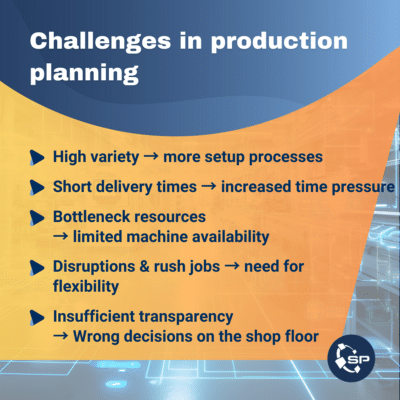
Typical challenges:
- High set-up costs due to a wide variety of variants and small batch sizes
- Short lead times combined with high on-time delivery rates
- Increasing cost pressure due to global competition and energy prices
What does detailed planning achieve?
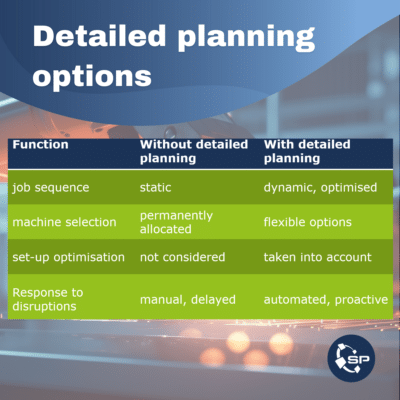
Whilst rough planning often involves only approximate allocations, detailed planning brings genuine transparency and controllability to processes. Orders are specifically allocated to machines and their sequence is determined in a targeted manner – particularly taking into account bottlenecks, set-up sequences and production-related dependencies.
Typical functions of detailed planning:
- Rerouting orders to alternative machines
- Optimising the order sequence per machine
- Splitting orders into smaller batches
- Combining small orders into larger batches
The result: better utilisation of capacity, stable processes and on-time production – even under complex conditions.
Bespoke optimisation models
Every sector has its own specific requirements – whether it involves workshop, assembly line or mixed production. That is why we develop bespoke models tailored to your production structure and objectives. In collaboration with our experts in production planning and business intelligence, we create solutions that go far beyond standard tools.
Examples of successful optimisation projects:
- Production sequence optimisation for multi-stage manufacturing with allergen restrictions (food industry)
- Waste minimisation in the timber and packaging industry
- Route and storage location optimisation in intralogistics
- Supply chain optimisation for a German car manufacturer
Planning that adapts – not the other way round
Whether it’s complex planning constraints, frequent disruptions or a high number of variants: with the right optimisation concept, even challenging production environments can be managed efficiently. Our solutions combine mathematical models with industry-specific expertise – for detailed planning that really works.
Frequently Asked Questions
What is the difference between detailed planning and mathematical optimisation in production?
Detailed planning deals with the short-term, operational planning of orders, resources and sequences in day-to-day manufacturing operations. Mathematical optimisation comes into play where standard software reaches its limits and a highly specialised planning problem requires a bespoke algorithm. In practice, the two complement each other; a mathematical optimisation solution can form part of a detailed planning solution.
What advantages does detailed planning software offer over traditional planning in Excel?
Unlike a static spreadsheet, detailed planning software takes capacity, sequencing and constraints into account simultaneously and immediately shows the impact of a rescheduling within the overall context. This reduces the need for manual coordination and makes planning decisions transparent, even when orders or capacities change at short notice.
Why is standard ERP functionality often insufficient for detailed planning?
ERP systems usually only model rough planning rules and reach their limits as soon as several constraints need to be taken into account simultaneously – such as set-up times, staff availability and material availability interacting with one another. A dedicated detailed planning solution models these interdependencies and thus provides more realistic planning proposals than the standard logic of an ERP system.