

Hanau Tram: Simulation shows which propulsion technology suits the fleet
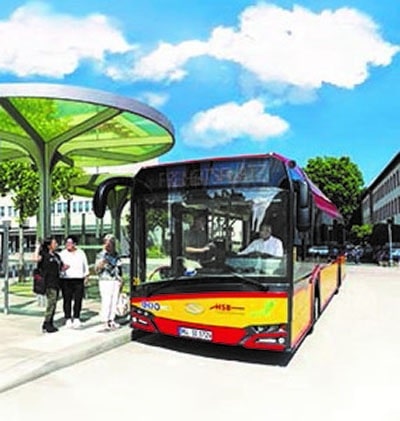
Hanauer Straßenbahn GmbH (HSB) operates public bus services in Hanau, comprising 12 routes, a route network of around 100 kilometres and 170 stops. The fleet comprises 64 buses, including 37 single-deck buses, 26 articulated buses and one midibus, supplemented by a daily reserve of three articulated and two single-deck buses. As part of the SimCityNet research project, HSB, in collaboration with SimPlan and Frankfurt University of Applied Sciences (Frankfurt UAS), has investigated how the bus fleet can be converted to alternative propulsion systems.
Starting point: Regulatory pressure coupled with high financial risk
The EU’s Clean Vehicles Directive stipulates that 65 per cent of new vehicle purchases between 2026 and 2030 must be powered by alternative drive systems, of which at least 32.5 per cent must be zero-emission. For HSB, whose fleet had been entirely conventionally powered up to that point, this meant a transition fraught with many unanswered questions: Vehicle range, charging infrastructure, depot design and the costs of different propulsion concepts could not be reliably estimated. A large-scale conversion of the fleet based on guesswork entailed a correspondingly high financial risk.
Objective: To establish a basis for decision-making prior to investment
Before investment decisions are made, the impact of different propulsion technologies on real-world operations needs to be made clear. As part of the SimCityNet project, a digital twin of tram operations was to be created to answer the following questions:
- How do fleet requirements change with battery-electric buses of varying ranges
- How does a fleet consisting solely of fuel cell trams compare
- Which mixed fleet combining both technologies offers the best balance between costs and investment
- What requirements does this entail for charging infrastructure and depots
The project ran from August 2019 to July 2020, funded by the Hessen Agentur (grant number 767/19-87), with Hanauer Straßenbahn, Hanau Infrastruktur Service (HIS), Hanau Wirtschaftsförderung GmbH and Frankfurt UAS as consortium partners.
Solution: Simulation of route operations using AnyLogic
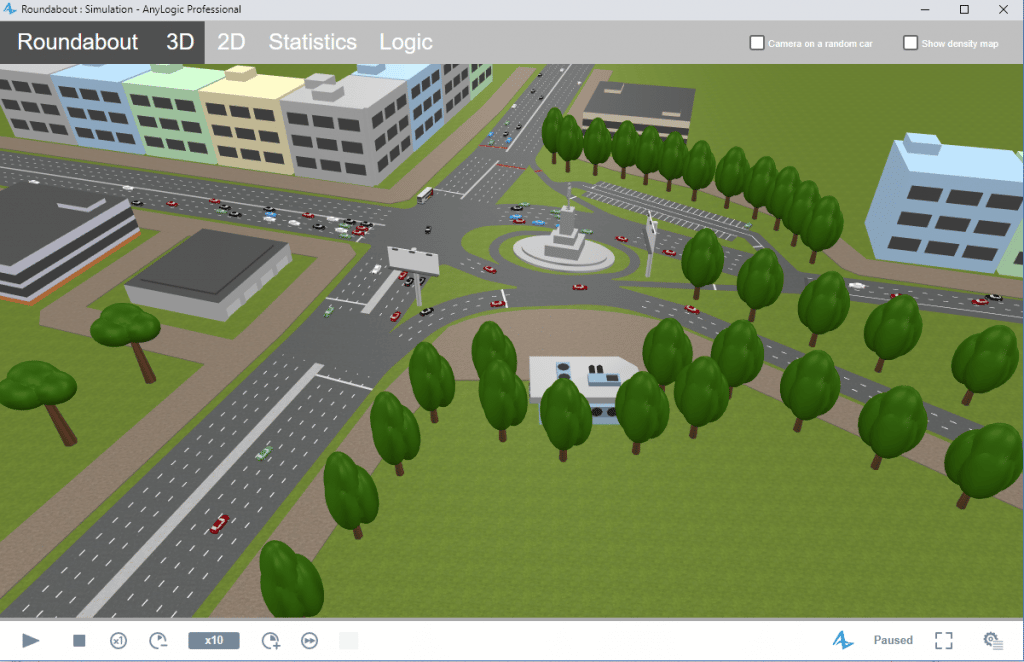
SimPlan created the digital twin of the tram operations using the multi-method simulation software AnyLogic. The model combines several approaches:
- Agent-based and discrete-event simulation of route operations
- A GIS module with visualisation based on OpenStreetMap data
- A graphical user interface for parameterising scenarios
- An optimisation heuristic for route planning developed within the project
- Excel-based configuration of operational data and vehicle parameters
This model enabled various fleet scenarios to be simulated, each based on the actual route structure and real-world operational data from HSB.
Results: Clear cost advantages for a mixed fleet
The simulation compared several propulsion scenarios:
- Battery-electric fleet, Type I with a range of 170 to 200 kilometres: 45 per cent more vehicles required (from 64 to 93 buses), cost savings of 43 per cent in normal operation and 24 per cent in winter operation, whilst operational performance increased by 2.5 per cent
- Battery-electric fleet, Type II with a range of 350 kilometres: 17 per cent more vehicles required (from 64 to 75 buses); under normal conditions, no additional vehicles required
- Pure fuel cell fleet: operation possible without the need for additional vehicles, cost savings of 19 per cent, limited by high hydrogen prices, refuelling processes comparable to those of diesel buses, but implementation in Hanau is difficult due to unresolved issues regarding hydrogen supply and storage
- Mixed fleet comprising Type II battery-electric buses and around 20 fuel-cell buses: fleet size remains constant at 64 buses; 22 per cent cost savings on propulsion energy and maintenance; lower charging peaks and lower investment costs than with an all-battery-electric fleet
An additional energy consumption of around 40 per cent was factored in for winter range, whilst a power output of 150 kilowatts per charging point was assumed for the charging infrastructure. The mixed fleet proved to be the most economical and operationally favourable concept in the simulation.
Digital twins as a basis for decision-making for local transport operators
Local transport operators across Germany face the same challenge as HSB: they must convert their fleets to alternative propulsion systems without knowing in advance exactly how range, charging infrastructure and costs will actually play out in real-world service operations. A digital twin makes these effects visible before the investment is made and replaces assumptions with reliable figures on fleet size, costs and infrastructure requirements. The SimCityNet project shows that a mixed fleet comprising different propulsion technologies often performs better than a one-size-fits-all solution, and that this can only be demonstrated by simulating specific operational scenarios.