

Would you like to assess your intralogistics and warehouse capacity using a digital twin before investing?
SimPlan supports companies in the manufacturing and logistics sectors in developing digital twins for material flow, warehousing and transport systems, from the initial feasibility study right through to the simulation of specific expansion scenarios.
Aluminium manufacturer: Digital twin reveals bottlenecks in warehousing and logistics
The customer operates an aluminium rolling mill where coils are delivered by rail, processed on several production lines and then dispatched. Because production lines, cranes, forklifts, coil transport trolleys and various storage areas work in close coordination, the company wanted to digitally map the entire material flow before implementing changes to logistics and storage capacities.
Initial situation: Complex material flow between production lines, warehouses and transport equipment
Each coil follows an individual work plan within the plant, which may consist of several processing steps. Cranes, forklifts and coil transport trolleys handle the transport between goods-in, production lines and the various storage areas within the factory, on the factory premises and off-site. As movements, warehouse utilisation and capacity limits influence one another, it was difficult to estimate how many transport stages a coil actually required before dispatch and where bottlenecks would arise. In addition, the company needed to be able to compare several expansion options for the warehouse without actually implementing them.
Objective: To test the logistics concept for bottlenecks and ensure the feasibility of expansions
The customer wanted to use the simulation to clarify the following questions:
- Where do potential bottlenecks occur in the existing logistics concept
- How does an overload affect plant, warehouse and transport equipment
- How do different production programmes behave in the model
- Which of the planned expansions best safeguards the logistics system against future requirements
The simulation was intended to be as close as possible to real-world operations, i.e. to use actual production and order data rather than just assumed values.
Solution: Digital twin of the entire plant in AnyLogic
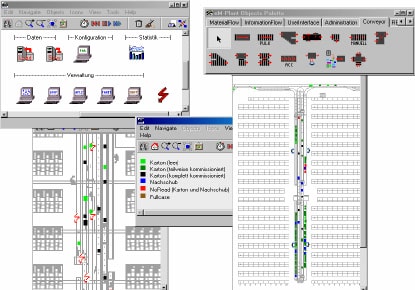
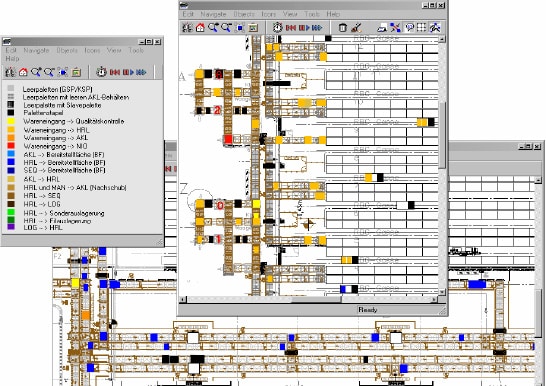
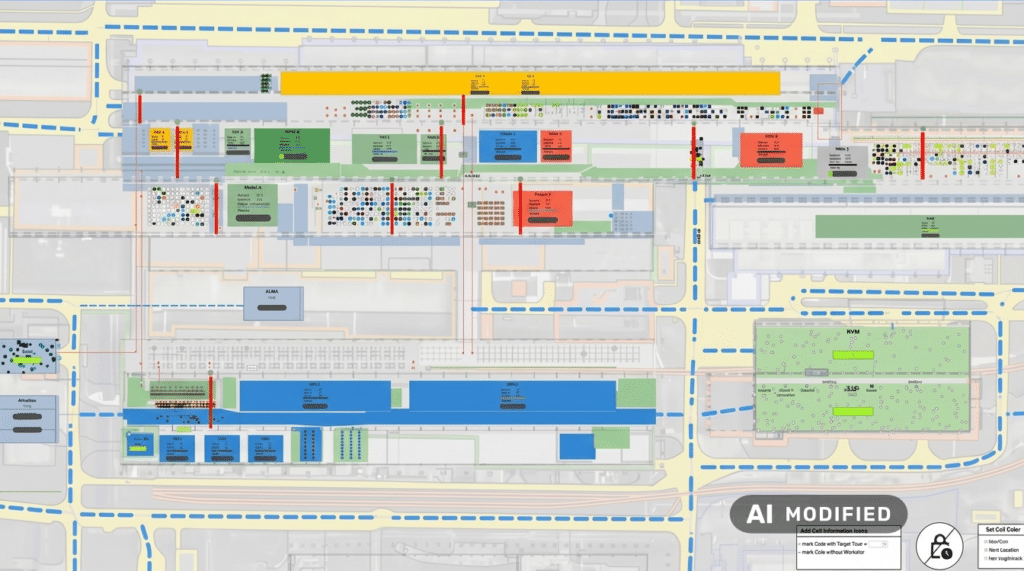
SimPlan modelled the plant as a digital twin in AnyLogic, from the delivery of the coils by rail right through to dispatch. As each coil passes through the simulation individually, the model also depicts the splitting and merging of coils, for example when a bundle is divided into several packages. Machines are modelled as simplified black boxes with their own parameters for cycle time and fault behaviour, whilst cranes, forklifts and coil transport trolleys move through the layout at realistic speeds and with realistic acceleration.
The customer defines the logistics control – such as which warehouse a coil is sent to from which machine, or the criteria used to prioritise transport orders – via rules and can adjust these at any time. To ensure the model operates in line with real-world conditions at the plant, production and order data from the customer’s SAP system is fed directly into the simulation. SimPlan delivered the simulation as an executable Java file, enabling key users within the company to use the model without needing their own AnyLogic licence.
To evaluate potential expansions, the team tested three expansion scenarios within the model:
- An additional warehouse within an existing area, which is also available for regular stock management
- A warehouse expansion including its own wagon unloading, connected to the existing logistics system via a bundle transport trolley
- An additional automated crane in a heavily utilised warehouse area, supplemented by new handover points for bundle transport trolleys
Results: Expansion scenarios comparable and logistics rules verifiable
Using the digital twin, the customer was able to test changes to the logistics rules of the existing system in advance within the model, rather than testing them directly whilst operations were ongoing. Furthermore, the three expansion scenarios could be directly compared with one another, as the simulation for each scenario showed how equipment, warehouses and transport vehicles would be utilised under the respective configuration. This provided the customer with a robust basis for deciding on future investments in warehousing and logistics.
Why it’s worth looking at intralogistics before investing
This case study demonstrates how a digital twin helps to evaluate complex material flows without having to invest in real plant or warehouse space. Because the model uses real production data, it is possible not only to test existing rules but also to compare several expansion options before a decision is made. For companies with similarly complex material flows between plants, warehouses and transport vehicles, this approach can help avoid misguided investments and identifies at an early stage which expansion will have the greatest impact on logistics.
A digital twin for logistics and material flow is often also a first step towards virtual commissioning. This is because, once a model replicates the real-world material flows and rules of a plant, the same foundation can later be expanded to virtually test the control technology before it is put into operation. Anyone investing in a logistics simulation today is simultaneously creating a foundation upon which emulation and virtual commissioning can be built.