


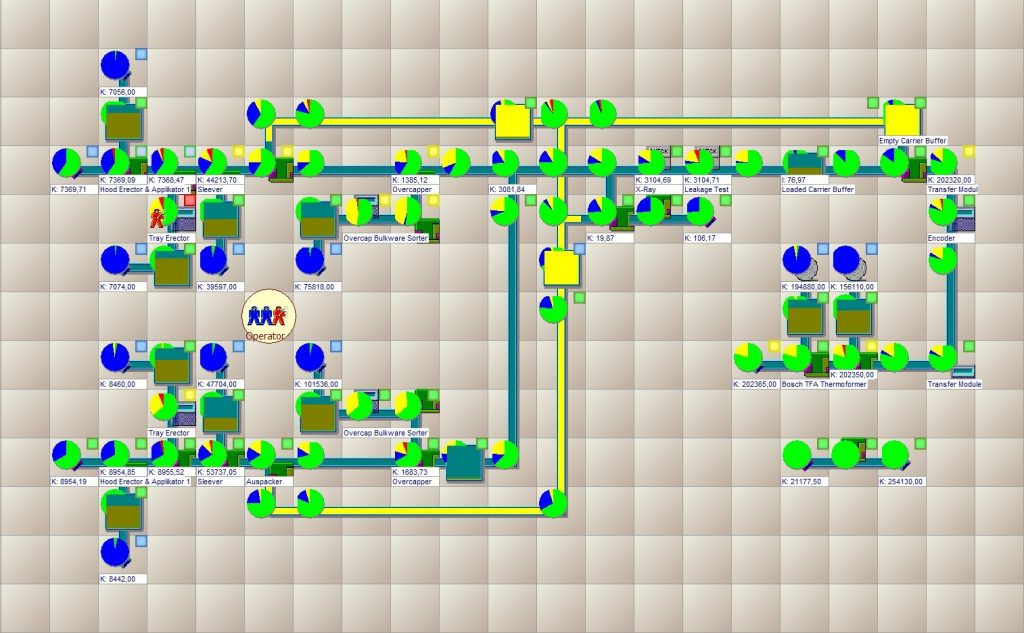
PacSi model of a line for filling and packaging baby food with carrier circulation system, including weak point analysis
PacSi – Simulation of manufacturing and packaging plants in the process industry
Introduction to the tool
PacSi is a specialised simulation system for analysing and optimising manufacturing and packaging plants in the food, pharmaceutical, cosmetics and chemical industries.
The software helps companies to realistically map complex production and packaging lines and to reliably determine key performance indicators early on in the project. PacSi provides a sound basis for decision-making, especially for highly interlinked plants with high demands on speed, availability and process reliability.
For those new to material flow simulation, PacSi offers structured access to dynamic simulation without the need for programming knowledge.
Areas of application and typical uses
PacSi is used wherever interlinked systems with discontinuous processes are planned, evaluated or optimised:
- Filling and packaging lines in the food industry
- Production facilities in the pharmaceutical industry
- Cosmetics and consumer goods manufacturing
- Chemical process chains
- Lines with carrier systems or complex buffer systems
Typical questions are:
- What line capacity is realistically achievable?
- How large do buffers need to be?
- What impact do disruptions have on overall availability?
- How do set-up times or order changes affect performance?
- Where do bottlenecks occur in the material flow?
Key features and strengths
PacSi is based on dynamic, time-discrete material flow simulation. This allows even complex scenarios to be calculated in a short time.
Key strengths:
- Mapping of material flow and control logic
- Consideration of time- and quantity-dependent processes
- Simulation of disruptions and availability
- Analysis of the efficiency of individual components and the overall system
- Inclusion of thermal and rheological influences
- Rapid scenario comparisons
The simulation provides reliable key figures such as output, OEE-related variables, buffer utilisation and downtimes.
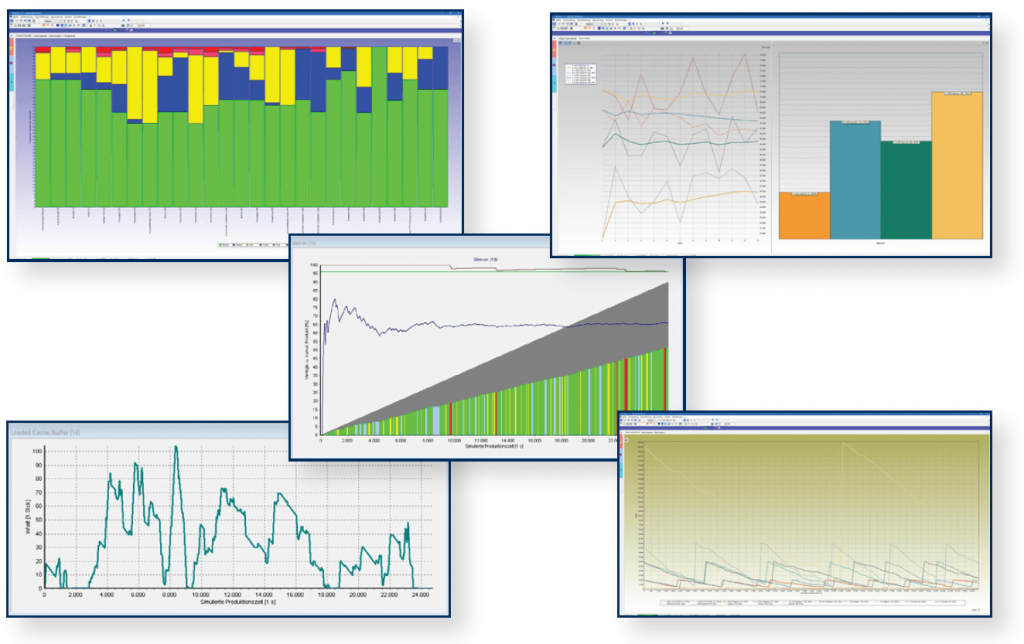
PacSi offers a wide range of evaluation options
PacSi contains all the functions necessary for model creation, simulation runs and evaluation of results. These functions are based on a standard element library consisting of verified elements.
PacSi can be used for decision-making at every stage of a project, both in planning and for process optimisation. Using the system requires detailed process knowledge of the plant to be modelled. However, complex mathematical calculations or programming skills are not necessary.
Structure and available modules
PacSi contains a verified standard element library for typical components of manufacturing and packaging plants.
Line structure and efficiency
- Consideration of:
- Machines
- Interlinking elements
- Number of operators
- Manual packaging
Detailed operator strategy
- Consideration of:
- Operator position
- Travel times
- Priorities of the activity
- Distinction between:
- Operator activity and
- Troubleshooting
Production optimisation
- Consideration of:
- Layout variants
- Line performance
- Fault behaviour
- Set-up time matrix
- Order size
- Planning scenarios
- Delivery date
Versions and licence models
PacSi is used in two ways:
- Use in simulation projects
- Licensing for independent use within the company
Independent use is particularly suitable for:
- Machine builders
- Line planners
- Production engineers
- Technical project managers
Details on licence models should be added in consultation with the manufacturer.
Integration and interfaces
PacSi can be combined on a project-specific basis with:
- Production data
- Layout information
- Planning key figures
- ERP or MES data
.
Close integration with planning processes enables use in early concept phases as well as in optimisation projects in existing systems.
Frequently asked questions (FAQ)
Do I need programming skills?
No. Technical process knowledge is required, but no programming.
For whom is PacSi particularly suitable?
For companies with complex interlinked production and packaging lines, as well as for mechanical engineers who need to demonstrate performance.
In which project phase is PacSi used?
In the concept phase, detailed planning and for optimising existing plants.
What key figures can be determined?
Line performance, availability, bottlenecks, buffer dimensioning, effects of disruptions.
Manufacturer and purchase
PacSi (like the SimPacSi app) is primarily developed and maintained by the SimPlan branch in Dresden.
The system is used for simulation services and is also offered as a licence solution for independent use.