


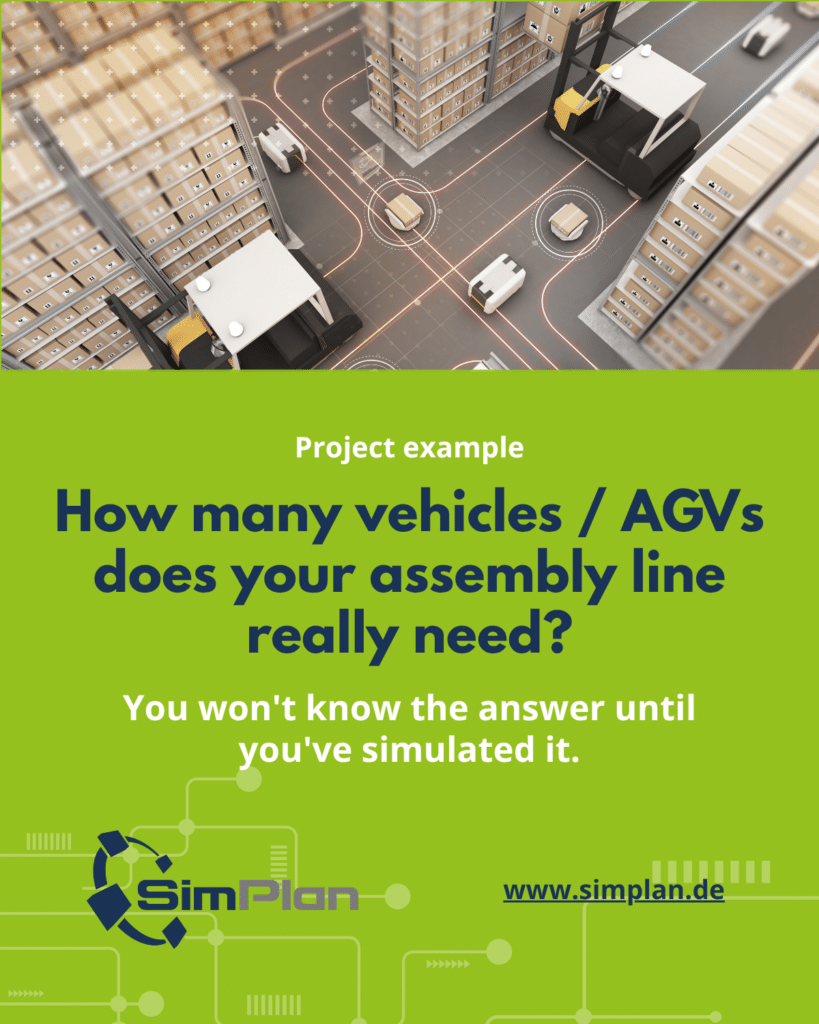
Simulation as a basis for decision-making in AGV planning
When planning an Automated Guided Vehicle (AGV) system, one of the most important questions is: How many AGVs are actually required? Too few AGVs jeopardise throughput. Too many, on the other hand, result in unnecessary investment costs. This case study from the field of automated assembly technology demonstrates why this question cannot be answered using a static calculation.
Background: Fully automated assembly based on an AGV system
A leading system integrator specialising in automated assembly technology was planning a fully automated vehicle assembly line. The core of the concept: all transport tasks within the line are handled by automated guided vehicles (AGVs). These include the retrieval of batteries by a lifter, the battery-vehicle mating process, and a series of other automated assembly steps.
Before a single vehicle was ordered, the project managers asked themselves three key questions:
- Can the system achieve the required throughput?
- How many AGVs are actually required?
- Will the planned battery-loading concept stand up to the rigours of day-to-day operation?
Three challenges that no static calculation can solve
1. Stop-and-go and continuous flow in the same system
The planned line combined two operating principles that follow different logics: stations where the AGVs stop at set intervals, and areas where they travel continuously. This combination creates interactions that cannot be reliably modelled using traditional design formulas. They have a significant impact on the achievable throughput.
2. Real-world driving behaviour influences the results
AGVs accelerate and decelerate. This may sound obvious, but it is regularly overlooked in static planning. In a tightly synchronised assembly line, these times add up to become a significant factor. Anyone who ignores them is planning out of touch with reality.
3. The FTF battery charging concept
FTFs require energy. Questions such as when each vehicle charges, how many charging points are required, and how charging affects availability and thus throughput can only be answered over time. A static analysis does not provide reliable insights here.
The simulation approach: dynamic modelling instead of rules of thumb
Using Plant Simulation, the entire line was modelled in detail. The model took into account the actual acceleration and deceleration behaviour of all vehicles, the operational mix of stop-and-go and continuous operation, and an automatic charging management system with various strategy options.
Instead of a single configuration, several scenarios were compared: different numbers of AGVs, various layout variants and alternative charging strategies. This allowed the solution space to be systematically narrowed down until the optimal configuration was identified.
Results: No surprises after go-live
The simulation study provided clear answers to all outstanding questions:
- The required throughput was verified.
- The optimal number of FTFs was determined.
- The layout was validated.
- The battery charging concept was validated.
All project stakeholders worked on the basis of shared decision-making criteria.
This meant that, even before implementation, a sound basis for decision-making was available regarding the number of vehicles, the layout and the charging concept.
The overarching lesson: AGV planning requires dynamic methods
This real-world case is not an isolated incident. In projects involving the planning of automated guided vehicle (AGV) systems, the same questions arise time and again, regardless of whether the context is vehicle assembly, intralogistics or production supply.
Whether it is vehicle assembly, AGVs in a beverage manufacturer’s block storage facility or mixed traffic in tyre production: simulation projects at SimPlan consistently highlight the same questions:
- How many vehicles are actually required?
- Where do bottlenecks arise under real operating conditions?
- Will the concept hold up even during peak loads?
Anyone who only answers these questions after the go-live will pay the price, for example through retrofitting costs, throughput problems or an oversized vehicle fleet.
Simulation is not merely an optional extra here. It provides a robust basis for decision-making before investments are made in vehicles, layout or infrastructure.
Are you planning an AGV project?
Are you planning an automated guided vehicle (AGV) system or looking to determine the optimal number of AGVs? We can support you with simulation studies to design vehicle fleets, material flows and loading concepts.
You can find further case studies, technical articles and practical examples on the SimPlan blog and in the SimPlan podcast.