

Simulation ensures separate material flows in GMO-free production
Garant Tierfutternahrung GmbH produces compound feed at three sites and employs around 160 staff. The company generates a turnover of approximately 90 million euros and looks back on a tradition of more than 50 years in compound feed production. Since 1990, Garant – Lagerhäuser’s pan-Austrian compound feed brand – has led the Austrian market in this sector.
Initial situation: Strict separation of GMO and non-GMO materials required
Genetically modified organisms (GMOs) and their derived products must not be used in GMO-free programmes, nor in organic programmes. As GMOs are widespread in conventional agriculture and food production worldwide, there is a growing risk that products declared as GMO-free may be unintentionally contaminated. Compound feed mills must therefore strictly separate the material flows of GMO raw materials and non-GMO raw materials (OGT, ‘Ohne Gentechnik’). In practice, this separation severely restricts production planning and control, as several fixed rules apply at the Graz plant:
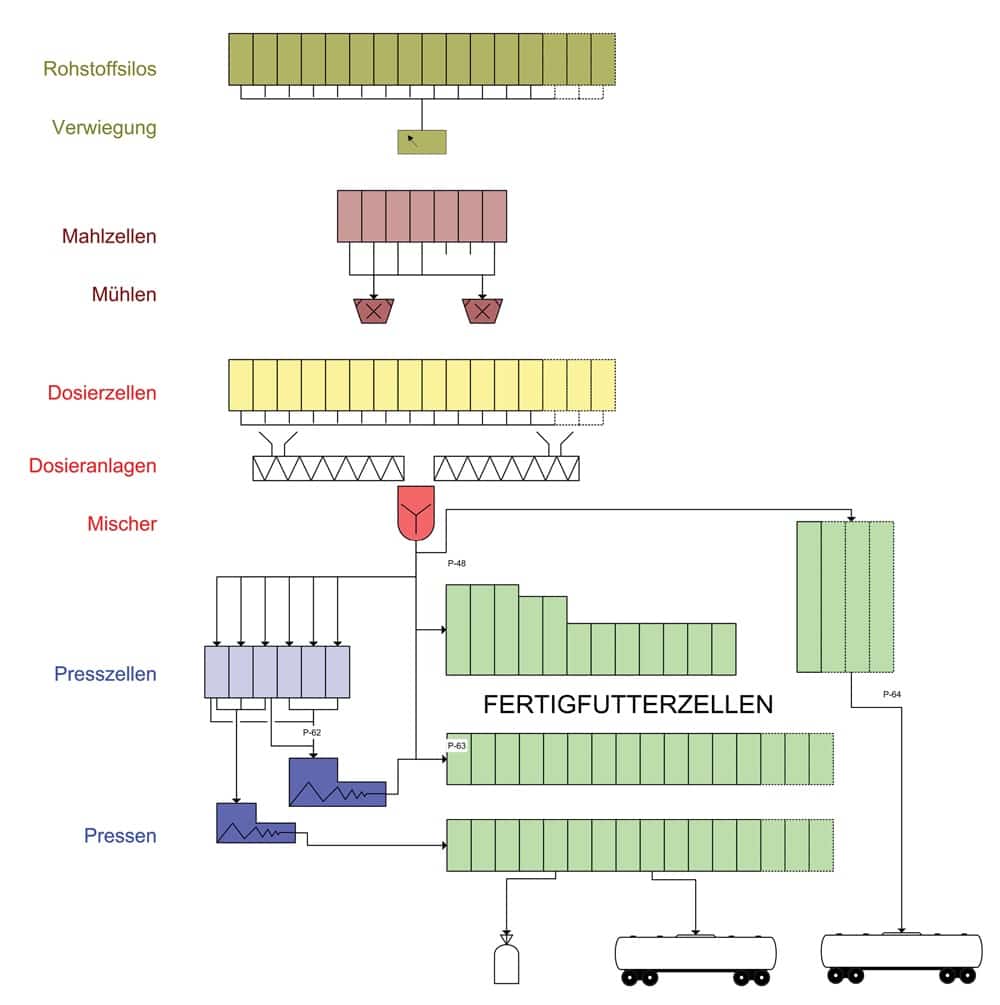
- Not every press is connected to every finished feed cell.
- Not every press cell is connected to every press.
- The mixer is not connected to every finished feed cell.
- Not every press can produce every type of pressed product.
- During a product changeover, no material must be carried over – neither in the press cells, nor in the finished feed cells, nor during transport.
To ensure the production manager complies with all these rules, he repeatedly runs so-called flush batches, as this is the only way to reliably prevent carry-over. However, this incurs costly set-up times.
Objective: To assess the impact of the restrictions on capacity and investment
SimPlan Austria was tasked with using the simulation to provide concrete answers to two questions. Firstly, the aim was to determine the plant’s marginal capacity, as the aforementioned restrictions reduce the actual usable capacity significantly below the theoretical plant capacity. Secondly, the simulation was intended to validate a specific investment measure relating to the ready-made feed cells before Garant implemented it.
- Highlight the impact and consequences of the GMO restrictions on production
- Determine the marginal capacity of the Graz plant
- Conduct a thorough assessment of the investment decision regarding the ready-made feed cells
Solution: Simulation model maps material flow and control strategies
SimPlan Austria modelled the entire Graz compound feed plant, with an annual production capacity of almost 60,000 tonnes, in a simulation model. The model follows the actual material flow: raw material cells store the material, the central weighing system conveys it to the grinding cells, and from there it enters the mills. The ground material is then held in the dosing cells, from which the recipe retrieves the appropriate quantities and the mixer blends them. Mealy products then flow directly into the finished feed cells, whilst pressed and expanded products are routed via pressing cells to the two presses.
A particular challenge was modelling the control strategies, as Garant processes a wide variety of products with highly fluctuating order volumes. The model therefore had to take various loading strategies into account and sequence the loaded orders whilst adhering to the carry-over matrix. The forward-looking availability of extrusion cells, extruders and finished feed cells is also factored into the sequence planning. SimPlan additionally tested the use of heuristics, such as genetic algorithms, and assessed within the model how effectively they improve the order sequence.
Results: Model highlights capacity limits and optimises order sequencing
The simulation model maps the entire plant – including material flows, silo capacities, and filling and conveyor systems – thereby highlighting the impact of GMO restrictions on capacity and planning. Garant now uses the model to optimise order sequencing using various heuristics. If a heuristic proves effective in the model, Garant implements it in a supporting planning tool for day-to-day operations.
Simulation as a response to strict segregation requirements in food production
The Garant case highlights a problem that extends far beyond the compound feed industry. An increasing number of manufacturers in production and logistics are required to strictly segregate material flows, whether due to GMO regulations, organic certification or allergen-free requirements. These segregation requirements constrain production planning, often without those responsible being aware of the actual capacity limits. A simulation makes these limits visible before a company invests in new plant components, thereby providing a robust basis for decisions that would otherwise be based on empirical evidence.