

Automotive supplier: Evaluation of a Power and Free system for cockpit production
Initial situation: New system in the tendering process
A German supplier of vehicle components for the cockpit area was planning the production of a complex component and put a Power and Free system out to tender for this purpose. In order to be able to thoroughly evaluate both the technical performance of the system and the P&F supplier’s tender, the customer commissioned SimPlan to develop a simulation model.
Objective: To validate supplier planning and identify bottlenecks
The focus was on validating the supplier planning: bottlenecks were to be identified and eliminated before the system was actually built. In addition, a control system for a colour-sorting storage unit was to be developed.
Solution: Simulation model based on supplier and customer data
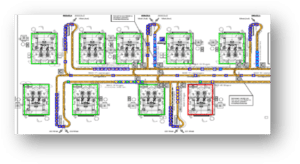
The system supplier provided all the necessary information on the P&F system, such as chains, carrier spacing and diverters. The customer itself supplied the data on the feeding and discharge systems. On this basis, SimPlan modelled the specific characteristics of the Power & Free conveyor system in detail, including stoppers, chain speed, link spacing and behaviour at junctions.
The model also allowed production systems to be switched on and off flexibly for different volume scenarios. The control strategy for the colour-sorting storage system developed within the model served as a blueprint for the P&F supplier to implement in the real-world system. Furthermore, the customer used the model internally to coordinate requirements across production, planning and logistics.
Results: Revised layout and validated control strategy
The simulation led to several improvements and revisions to the plant layout and provided a validated strategy for buffer control. Furthermore, the system’s maximum capacity at high rework rates could be determined, from which production targets could be derived. As a communication platform, the model helped to bring the planning department and production closer together.
Simulation as a common basis for planning
The case study demonstrates how a simulation model can be used not only to evaluate a supplier’s quotation, but also as a blueprint for real-world control and as a basis for communication between the supplier, production and planning.