

Johann HAY optimises new plant in advance using simulation
Johann Hay GmbH & Co. KG, headquartered in Bad Sobernheim, is a supplier of forged and machined components to almost all German and most European original equipment manufacturers in the engine, gearbox and axle sectors.
Initial situation: New plant for large rings with high product variety
The planned new plant is intended to manufacture large rings for wind turbines, amongst other applications. The high product variety places considerable demands on the flexibility of the production line. A particular challenge in the planning process lies in reconciling the necessary close sequencing of individual production steps with a decoupling of the systems that makes sense from a logistical perspective.
Objective: To validate the planning and identify the best layout option
The aim was to validate the planning, determine plant performance across different variants, identify the space required for material buffers and the optimal layout variant, and assess the benefits of new plant technologies. In addition, the simulation was intended to demonstrate how production orders should best be scheduled to achieve high plant utilisation and productivity. Key investment decisions, such as the type and number of furnaces or transport cranes to be installed, were to be made on the basis of the simulation results.
Solution: Modelling of all production stages from raw material to dispatch
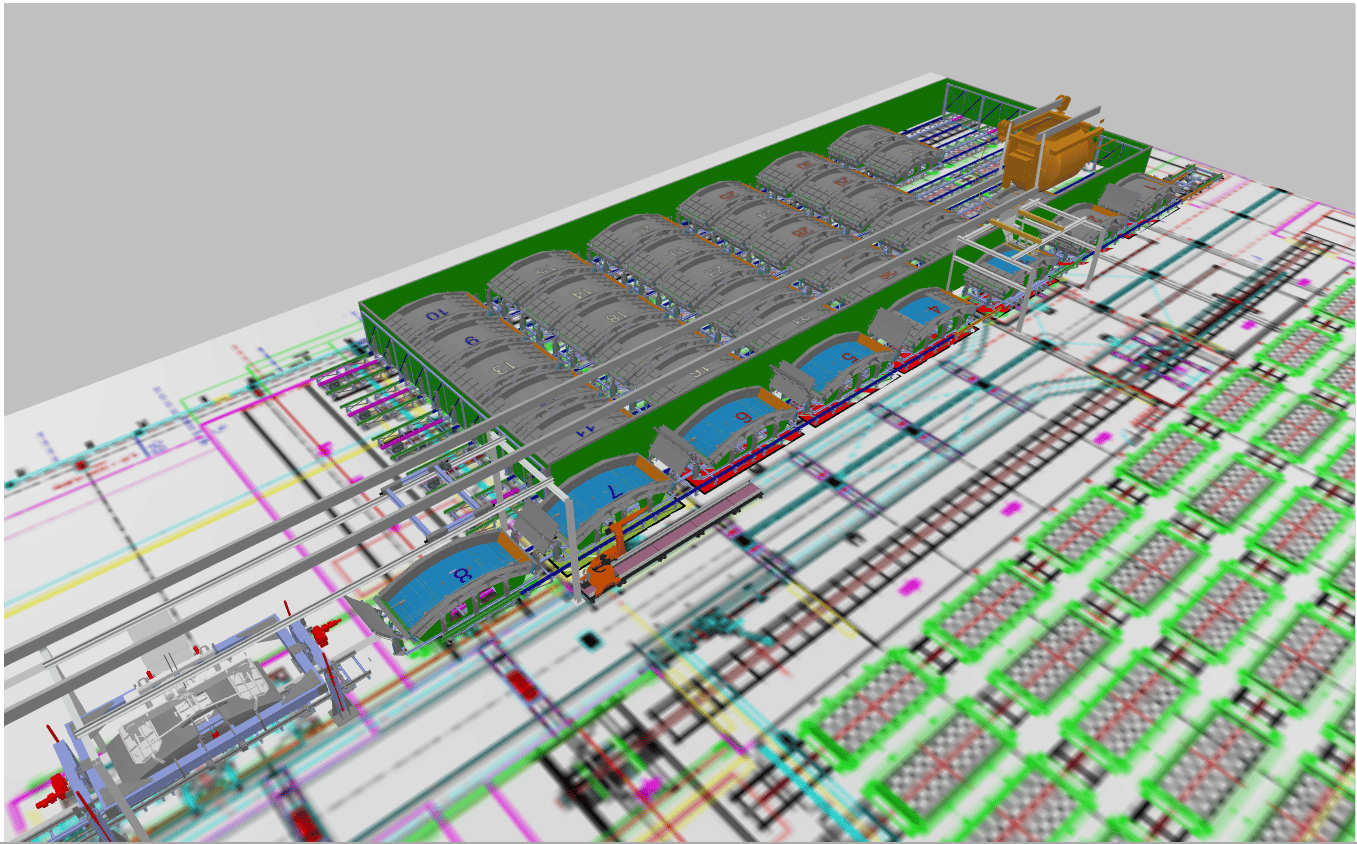
SimPlan modelled the planned production plant for large rings, including logistics from raw material to dispatch, covering all production stages: sawing, forging, rolling, hardening and tempering. The model enabled the examination of different layout variants and plant technologies, as well as the analysis of the effects of fluctuating customer requirements for different ring types. In addition, the simulation determined order lead times, stock levels and potential bottlenecks, and provided the basis for improvement measures.
Results: Investment decisions based on simulation
Using the simulation results, Johann HAY was able to make well-informed key investment decisions – for example, regarding furnaces and transport cranes – and validate the planning of the new plant prior to construction.
Simulation as the basis for investment decisions in new plant construction
The case study demonstrates how, in the context of a complete new plant construction, simulation can validate not only the layout but also specific investment decisions regarding plant engineering, even before the first piece of equipment is ordered.