


Simulation as a basis for decision-making when selecting a supplier in intralogistics
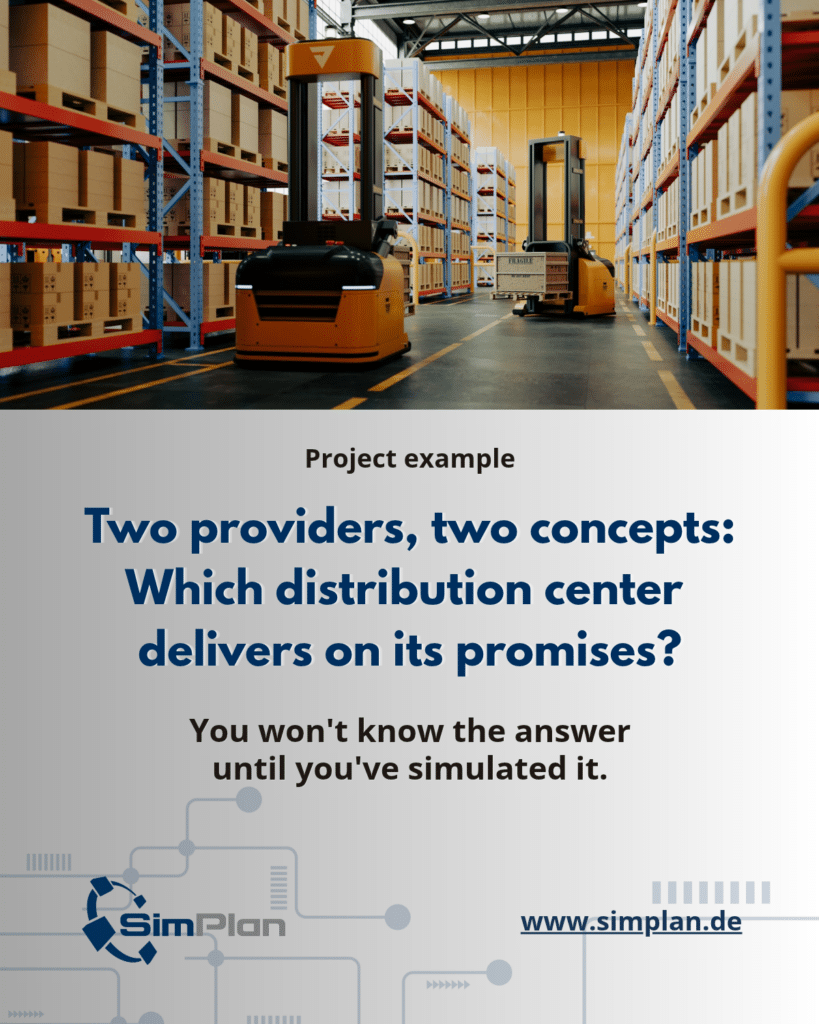
Anyone automating a new distribution centre usually has to choose between the concepts offered by several suppliers. Each concept promises to deliver the required performance. However, it is difficult to assess on paper whether it will actually deliver in practice, particularly when the suppliers rely on fundamentally different technologies. A project for a large retail company demonstrates how a material flow simulation makes it possible to evaluate such concepts before awarding the contract.
The situation: Two concepts, two technologies
The retail company was planning a new distribution centre. Two supplier concepts, which differed significantly in technical terms, were shortlisted. Among other things, the plans involved the use of an AutoStore system – an automated small-parts warehouse in which robots store and retrieve containers within a cubic grid – and a bag sorter, a suspended conveyor system that transports and sorts items individually in bags. It was not possible to determine with certainty from the tender documents alone how the concepts would interact with the overall material flow.
Three questions that needed to be clarified before the contract was awarded
- Do both concepts meet the required performance of the distribution centre?
- Where are potential problem areas that are not apparent in the tender documents?
- How can two technically different solutions be compared fairly?
The simulation approach: both concepts in a dynamic model
SimPlan modelled the planned distribution centre with both suppliers’ concepts in a dynamic material flow simulation. Unlike a static calculation, the simulation shows how order load, control systems and conveyor technology influence one another over time. This reveals whether a concept achieves the required performance only on average or consistently during ongoing operations. To model the system, the internal control rules of each concept also had to be understood.
Results: Weaknesses identified before the contract was awarded
The simulation revealed that some of one supplier’s internal decision-making rules were unknown. Had this concept been implemented, it would have created a ‘black box’ within the retail company’s own distribution centre. For the second supplier, the simulation showed significant fluctuations in the material flow rather than a consistent utilisation rate.
The simulation highlighted both weaknesses before a contract was awarded. It provided the retail company with a well-founded assessment of both concepts as a basis for selecting a supplier.
The overarching lesson: concepts need a common benchmark
This pattern is evident in many distribution projects. For a pharmaceutical company’s logistics centre, SimPlan compared the concepts of three bidders for a temperature-controlled, highly dynamic container warehouse. To ensure the results remained comparable, a master model with a standardised data framework was created in advance, into which each bidder’s concept was subsequently integrated. For a newly planned distribution centre for an online retailer, SimPlan simulated the same project for two suppliers. This enabled the end customer to compare both concepts on the same basis.
Three questions arise in almost every supplier comparison:
- Do you know the rules by which the system will operate later on, or are you buying a black box?
- Does the concept deliver consistent performance, or only an average daily performance?
- Are all concepts assessed under the same conditions?
Anyone who only answers these questions after commissioning will end up paying the price in the form of rectifications, dependence on the supplier, or a facility that fails to deliver reliable performance.
Are you planning a new or automated distribution centre?
Have your suppliers’ concepts tested using material flow simulation before awarding the contract. SimPlan operates as a neutral simulation service provider and evaluates supplier concepts for warehouses and distribution centres on a common, transparent basis.
You can find further case studies, technical articles and practical examples on the SimPlan blog.


