

Electronics manufacturer: Using simulation to determine staffing requirements in internal logistics
Initial situation: Organised structures that have evolved organically without overarching control
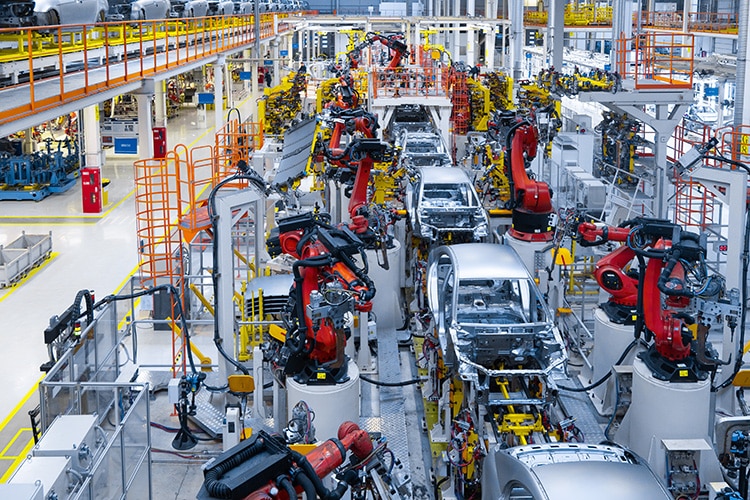
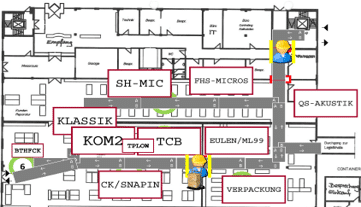
A medium-sized manufacturer of electronic components, which produces telecommunications units for vehicles manufactured by German OEMs, commissioned SimPlan to simulate future scenarios for its materials transport. Production had not been planned this way from the outset, but had evolved over the years in line with the company’s growth. It is spread across several floors, connected by a lift that is used both by staff and for supplying the production lines.
Logistics staff follow the same route when transporting product components between the warehouse, workstations and production lines. Without an overarching control system, the numerous pick-up and drop-off points within the company led to delays and the incorrect prioritisation of transport operations.
Objective: To determine staffing requirements for future growth
As the company continued to grow, the aim was to determine how many logistics staff would be required in future to meet the planned production capacity. To this end, stress tests were to be carried out for various future scenarios.
Solution: Simulation of development scenarios for plant and staff
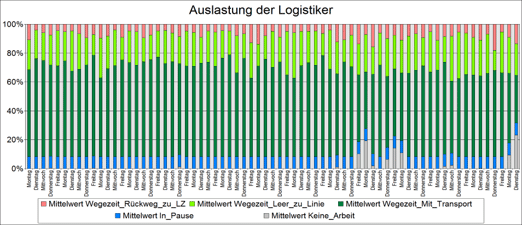
The simulation model enabled the client to run through various development scenarios using the existing system. This allowed conclusions to be drawn regarding the utilisation of production facilities, as well as the workload and management of logistics staff – providing a basis for assessing and evaluating collaboration and potential investments in production facilities.
Results: Data quality as the key to better management
The simulation first provided clarity on the data requirements necessary to evaluate the scenarios for an informed decision. It became apparent that the existing logistics processes were not clearly defined and were frequently adjusted on an ad hoc basis. The reported data in the ERP system was partly incorrect, as was the underlying master data, meaning that no definitive conclusions could be drawn. The simulation highlighted just how significantly data quality influences the results, and the data was improved accordingly. With better data, the level of automation increased immediately, as manual corrections and checks were no longer necessary. In addition, systematised processes were established, along with much-needed documentation.
Finally, model calculations were provided to the client, including those relating to the deployment of an additional logistics staff member and different scenarios for lift usage, to serve as a basis for further optimisation.
Simulation reveals where clean data is lacking
The case study demonstrates how a simulation not only calculates future staffing requirements but also reveals where data quality and process documentation within the company need to be improved.