


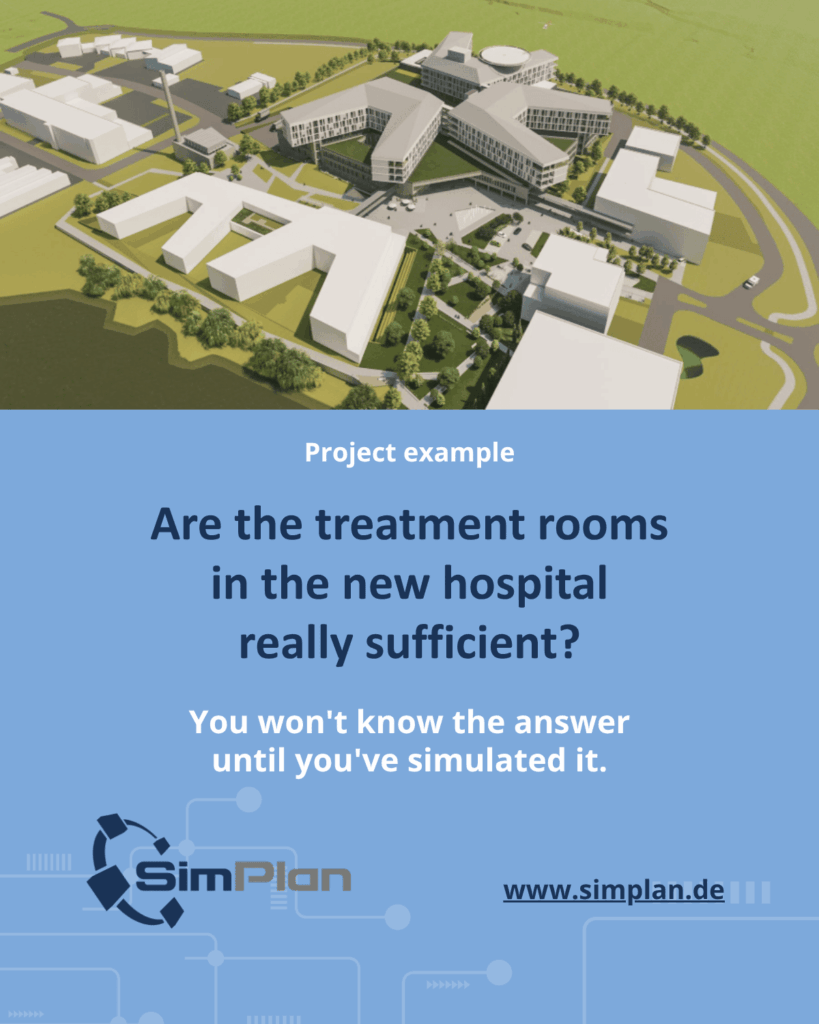
Simulation as a basis for decision-making in hospital planning
Bringing together three hospital sites – including St Elisabethen Hospital – into a new building: for the hospitals in the district of Lörrach, this was one of the biggest construction decisions in recent history. Around 2,200 staff, some 36,000 in-patient admissions per year and, ultimately, 814 planned beds plus 8 day-care places had to be accommodated in a single building, without compromising the quality of care and without over-planning in relation to actual demand.
Static capacity calculations provide an initial guide for such projects. However, they quickly reveal their limitations when processes are interdependent: for instance, when waiting times in A&E depend on how many patients are being treated simultaneously in the elective outpatient clinics, or when a single bottleneck in admissions leaves entire treatment rooms unused. This is precisely where the dynamic simulation came into play, which SimPlan developed in collaboration with ANDREE CONSULT for the functional floor housing the A&E department and elective outpatient clinics.
How the model was developed
Rather than using fixed average values, the simulation model mapped patient pathways, process times and room occupancy based on the actual floor plans. Patient numbers, medical requirements and consultation hours were incorporated as minimum, maximum and random distributions, rather than as rigid mean values. During regular coordination meetings with user groups from the hospital, the assumptions were reviewed and various scenarios run through before a single wall had even been planned.
What the simulation revealed
The result contradicted a widespread assumption regarding new hospital buildings: that more space automatically equates to greater safety.
- The planned room capacities fully met future requirements and even allowed scope for subsequent increases in service provision.
- It was not room capacity that was the actual bottleneck, but an understaffed reception desk.
- An additional temporary post in this one area solved the problem without the need to build any extra treatment rooms.
The managing director of the Lörrach District Clinics sums up the benefits as follows: “It has already paid for itself many times over.” The simulation thus went beyond the limits where a static calculation would have fallen short.
What clinic simulation can achieve beyond individual cases
The Lörrach example illustrates one of several possible applications. Simulation in the healthcare sector can be applied to virtually any area where patients, staff and spaces interact, and where a wrong decision would be costly or have serious consequences.
Planning for new builds and refurbishments
Before a single room is built or repurposed, a model can be used to check whether the planned number of beds, treatment rooms and staff is appropriate for the expected patient volume. This was the case, for example, with a ward at a university hospital in southern Germany, where a planned merger was assessed in advance to determine its impact on occupancy rates and staff deployment.
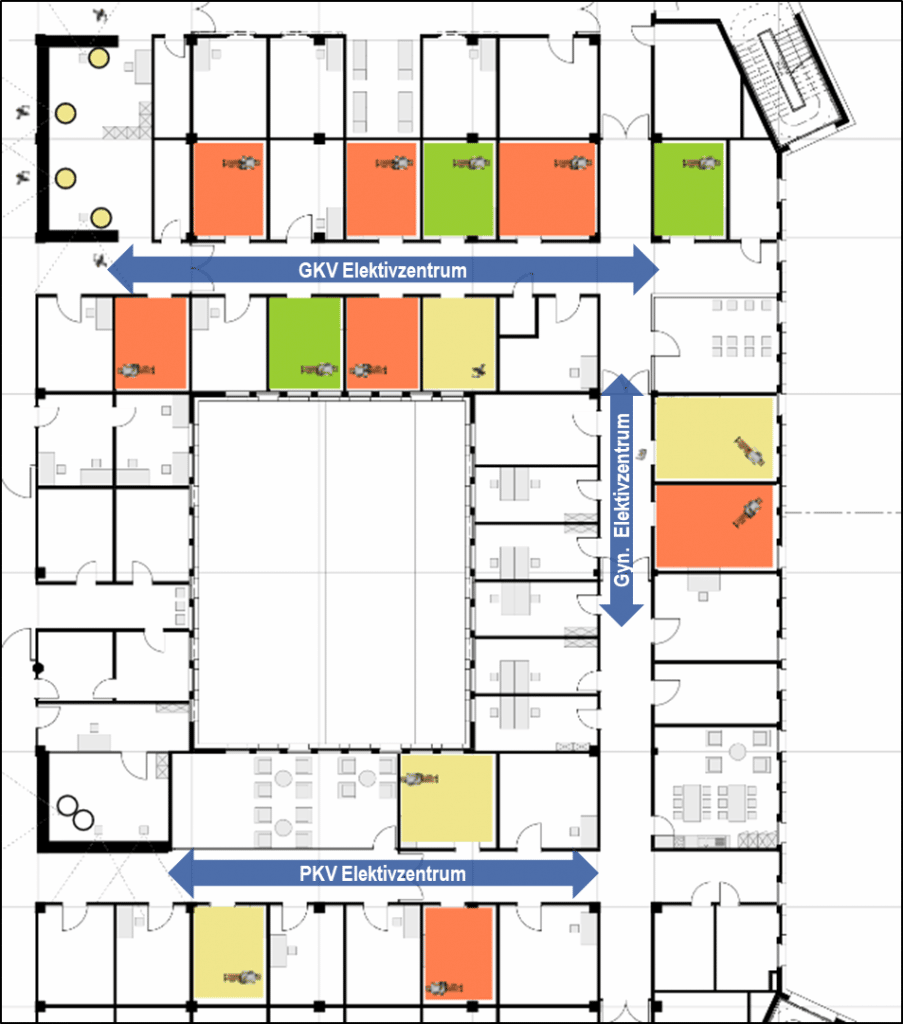
A&E and elective outpatient departments
Waiting times, treatment rooms and staff deployment can be weighed up against one another before they become a problem during day-to-day operations, as was the case at Lörrach Central Hospital itself.
Internal logistics
Automated transport systems for food, laundry, supplies and post are tested for their actual performance before any investment is made. At a hospital in southern Germany, such a simulation revealed that, due to structural constraints, the planned system would not have achieved the expected results – a misguided investment that was avoided thanks to the simulation.
Staff and Resource Planning
Simulation models highlight how the workload is distributed across shifts and wards, thereby providing a robust basis for staff deployment.
Psychiatric and other specialist areas
The effects of various influencing factors on treatment plans can also be modelled, for example when treatment options or occupancy patterns change.
Emergency preparedness
Scenarios involving epidemics, major incidents or evacuations can be run through the model without posing any risk to actual hospital operations.
The common thread running through these use cases is that planning errors can be identified using the model whilst corrections can still be made at no cost, rather than years later whilst the hospital is in operation.