

AI technology in use for process optimisation in production and logistics
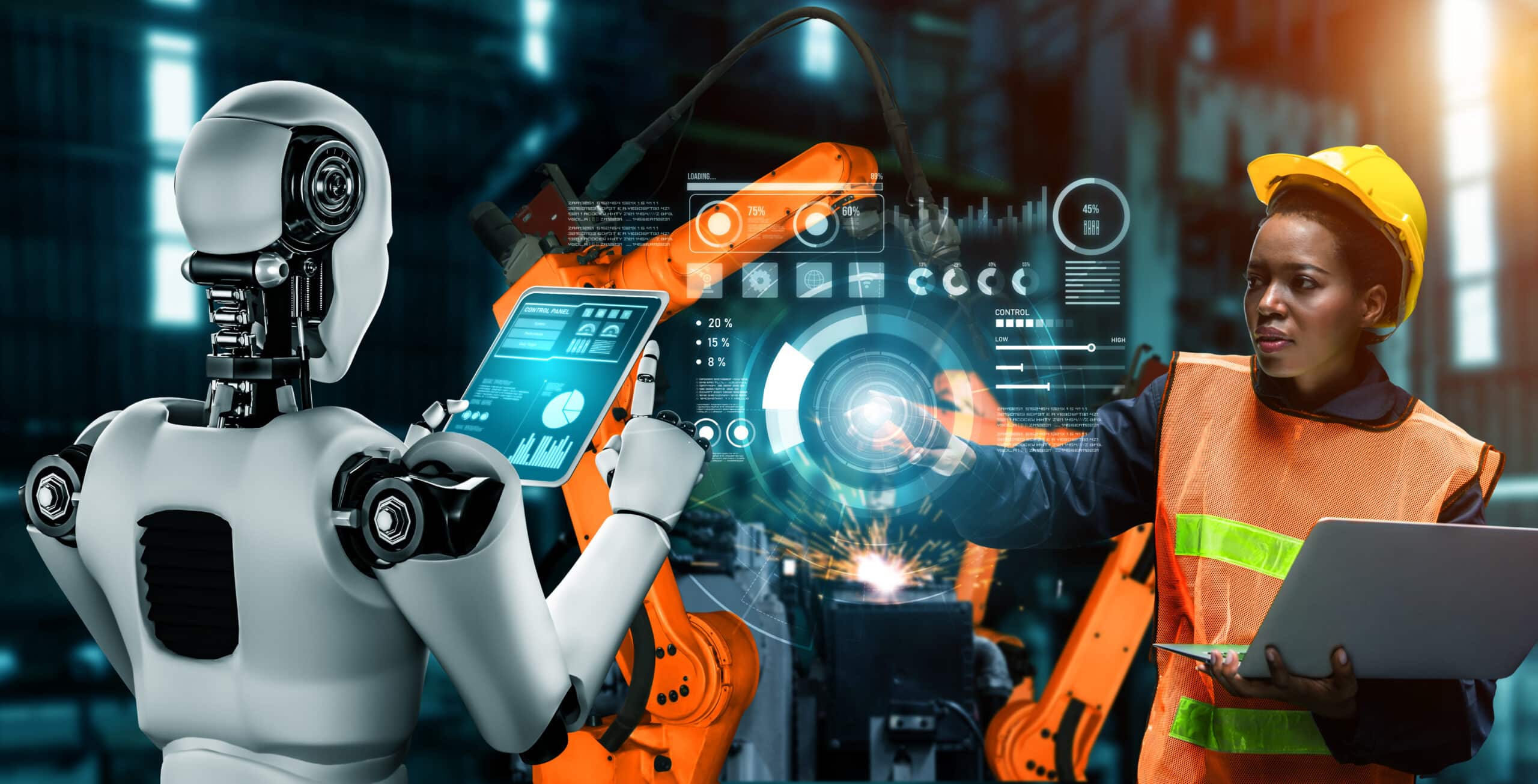
Artificial intelligence has become a key technology for analysing, optimising and intelligently controlling processes in production, logistics and the supply chain. Various AI methods can be employed for this purpose, such as reinforcement learning, machine learning or classification methods.
However, particularly with complex and dynamic processes, the question is not merely which AI method is suitable. It is also crucial to determine how an AI system can be reliably trained, tested and evaluated. This is where the combination of artificial intelligence and simulation offers unique opportunities.
Training and evaluating AI solutions safely
A key challenge in the use of AI lies in selecting and training a suitable solution. Training directly on the actual production or logistics system often involves risks. Particularly in the early stages of learning, an AI may make decisions that would have undesirable consequences in real-world operations.
Simulation models create a controlled and realistic test environment for this purpose. They can provide dynamic data from various scenarios and demonstrate to the AI the consequences of its decisions.
Simulation supports, amongst other things:
- providing realistic and dynamic training data
- examining different scenarios within a short timeframe
- testing AI solutions risk-free before deployment in the real system
- comparing different AI methods with one another
- quantitatively evaluating AI approaches against traditional optimisation methods
SimPlan provides the necessary simulation methods and technologies for such an environment. We also develop bespoke models and building blocks for our clients, which can be used to investigate and evaluate AI applications and prepare them for future deployment.
Generating valid data for simulation models
Many companies already have extensive data from production and logistics at their disposal. However, before this data can be used in a simulation model, it often needs to be checked, cleaned, supplemented or adapted for future scenarios.
AI methods can assist with this data preparation. For example, they help to identify anomalies, structure data or sensibly supplement missing information. This can reduce the effort required to provide suitable input data for simulation models.
Future prospects: How AI is transforming simulation
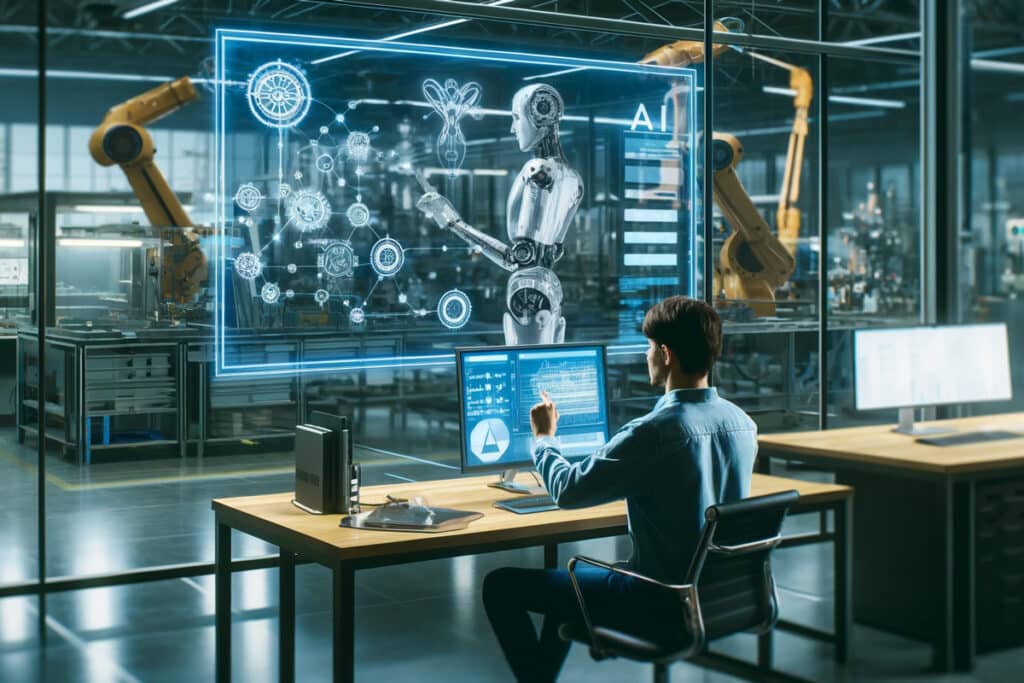
Artificial intelligence not only offers new opportunities for optimising production and logistics processes. It can also support the simulation process itself.
Potential exists throughout the entire workflow: from preparing input data, through creating and updating simulation models, to carrying out and evaluating experiments.
Creating simulation models more quickly and feeding them with data
Creating a simulation model currently requires manual work at many stages. Processes must be documented, data structured, models built and different scenarios defined.
In future, AI can support or automate some of these tasks. Generative AI, for example, can be used to structure information, fill in missing data or create model components.
This opens up various opportunities:
- reduced effort in creating and maintaining simulation models
- faster processing and analysis of large data sets
- simpler creation and evaluation of different scenarios
- Support in interpreting simulation results
- Lower barriers to entry for using simulation
The combination of AI and simulation can thus help to move more quickly from existing data and process information to a robust decision-making model.
Combining simulation, AI and reality
Of particular interest is the integration of AI with continuously updated simulation models and digital twins.
Real-world production and logistics systems continuously provide new information about machinery, plant, material flows and processes. A digital twin can capture this information and initially examine different decisions in a virtual environment.
AI can, for example, develop control decisions or suggest alternative courses of action. Simulation provides the environment for testing and quantitatively evaluating their effects before a decision is applied to the real-world system.
This creates a link between the real system, the digital twin, simulation and AI. In the long term, this will make it easier to update models and utilise them more effectively for the continuous optimisation of production and logistics processes.
Potential applications for production and logistics
Due to their complex workflows and large volumes of data, production and logistics offer numerous potential applications for combining AI and simulation.
Possible applications include, for example, production control, resource planning, material flow optimisation, factory planning or the control of automated logistics systems.
Generative approaches also open up new possibilities. AI can, for example, generate various solution variants, which are then quantitatively evaluated using simulation. Instead of manually developing and reviewing individual variants, larger solution spaces can thus be systematically explored.
Simulation plays a key role here: it visualises the effects of a proposed solution and enables evaluation based on specific key performance indicators.
AI and Simulation in Research
Many of these approaches are still under development. As part of our research and development projects, we are therefore focusing intensively on the question of how artificial intelligence and simulation can be meaningfully combined.
Among other things, we are investigating how AI can support model creation and data preparation, keep simulation models up to date, or contribute to the intelligent control of production and logistics systems.
Frequently Asked Questions
How can Artificial Intelligence be used in production planning and materials management?
In production planning, artificial intelligence is particularly helpful where large volumes of data need to be analysed automatically and decisions require data-driven support, such as when selecting suitable control strategies or generating valid data for simulation models. SimPlan combines AI methods with traditional simulation to ensure that the results remain transparent and can be applied to real-world processes.
What distinguishes the use of AI in logistics from classical simulation?
Classical simulation replicates known rules and procedures, whilst AI methods are used to recognise patterns within large volumes of data or to automate decision-making, for example when controlling processes with frequently changing conditions. SimPlan combines both approaches to ensure that results remain transparent and are not based solely on a black-box model.
What prerequisites should a company meet before implementing its first AI use case in production?
The data foundation is usually more important than the choice of algorithm; without sufficient valid process data, it is not possible to train a reliable model. SimPlan recommends clarifying, before the first project, which data is already available and how a repeatable procedure can be established, so that subsequent use cases can be implemented more quickly than the first.
Would you like to combine AI and simulation effectively?
We would be happy to discuss with you the potential applications for your production or logistics processes and how such approaches can be investigated and evaluated using simulation.