

Tyre manufacturer: Feasibility study for an automated guided vehicle (AGV) system in mixed traffic
Initial situation: Mixed traffic comprising AGVs, tugger trains and forklift trucks
A tyre manufacturing company commissioned SimPlan to carry out a simulation of the potential deployment of an automated guided vehicle (AGV) system. On-site, the intralogistics operations were organised as mixed traffic: in addition to the planned AGV, an automated tugger train and forklift trucks were to remain in use. This configuration had to be accurately modelled in the simulation.
Objective: To assess feasibility and determine the number of vehicles and control system
The key question was whether an AGV could usefully complement or partially replace existing forklift trucks. To this end, the simulation had to determine the required number of automated guided vehicles (AGVs) and predict the traffic load on the routes as well as any potential route overlaps with the forklift trucks. Should the decision be made in favour of an AGV system, the model was also intended to show which control parameters would need to apply to the individual systems to ensure optimal capacity utilisation and efficiency. Only with the right number of AGVs and a clear control concept can such a project be operated economically.
Solution: Simulation model for coil handling and production schedule
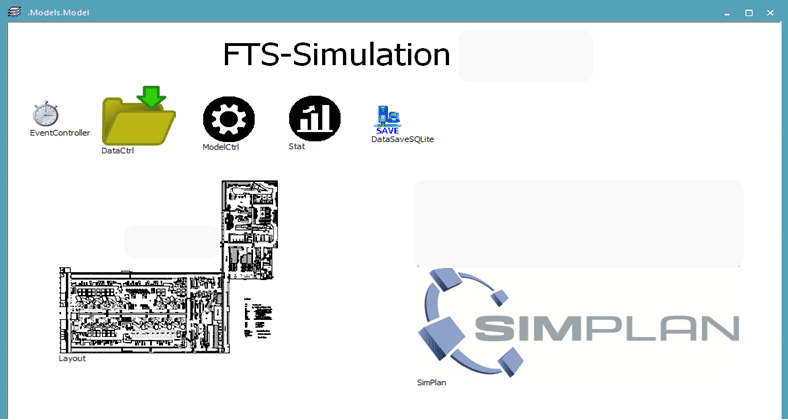
The simulation model was designed so that it could be used directly by the customer’s staff. It accurately modelled the handling of the coils and automatically calculated the production schedule for all systems based on fluctuating demand. Furthermore, the simulation determined the required buffer areas, the duration of the logistics processes, and the resulting lead time throughout the entire process. This made it possible to smooth out the intralogistics and prevent a bullwhip effect within the plant.
Results: Clear figures as a basis for decision-making
The simulation was developed within 45 days in close collaboration with the AGV supplier. It provided the logistics lead times requested by the customer, the exact number of AGVs required, and the changeover time for the reels under the new process. Another benefit of the collaboration was that communication between the AGV supplier and the customer became better structured, processes were documented, and a shared knowledge base regarding how the systems function was established within the company.
Ultimately, the customer decided against using an AGV. The reason: the supplier was unable to implement the control specifications identified by the simulation within the economic parameters.
Simulation as a basis for decision-making prior to investment
The study demonstrates how a simulation can provide clarity prior to a major investment, even if the result ultimately argues against the originally planned solution. For the client, this meant avoiding a misguided investment in a system whose control system would not have been economically viable.