


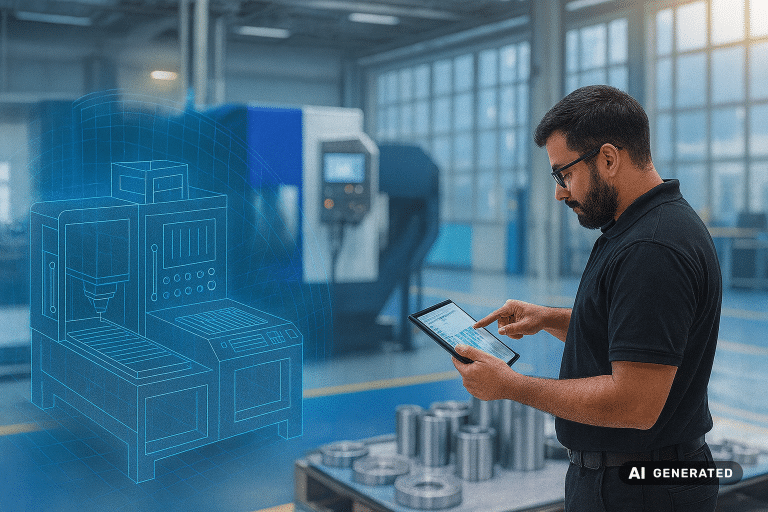
From simulation model to tool for operational decision-making
A 3D model of the factory shows what a plant looks like. It does not show how it is performing today, where a bottleneck will arise tomorrow, or what the consequences of a changed order sequence will be. For this, a model linked to data from ongoing operations is required: the digital twin.
A digital twin is a virtual representation of a real object or process that is linked to operational data and simulation models. It makes processes transparent, supports analysis and helps to manage processes throughout the entire life cycle of a plant. SimPlan supports companies in the manufacturing and logistics sectors every step of the way, from the initial simulation model in the planning phase right through to the digital twin in operation.
What distinguishes a digital twin from a simulation?
A traditional simulation study works with a fixed data set and compares scenarios, for example when planning a new plant. A digital twin, on the other hand, is regularly updated with current operational data, such as order statuses, cycle times, set-up times and availability. It therefore not only reflects how a system is planned, but also how it is currently performing.
How up-to-date this data needs to be depends on the specific application. For testing the daily production schedule, a data set current at the start of production is sufficient. For real-time monitoring and early-warning systems, continuous integration with the control system, MES or warehouse management is required.
Virtual commissioning is also part of this chain: here, the simulation model is linked to the real control system in order to test control programmes before live operation.
Why do many digital twins fail to provide a basis for decision-making?
Many projects focus on sensor technology, dashboards and data storage. This data shows what has happened. Only simulation reveals what might happen: new production concepts, material flows, capacities and bottlenecks can be assessed before changes are implemented. Emulation brings the control system into the picture. PLC programmes, plant logic and exception states are tested on the model, without the actual plant and without any production risk.
Successful projects therefore do not start with the technology, but with questions such as:
- Where do bottlenecks occur?
- How can the ramp-up be ensured?
- Which variant is more cost-effective?
- How can downtime be reduced?
The use case determines the digital twin, not the other way round.
How is a digital twin structured?
A digital twin integrates real-world operational data, simulation models, analysis algorithms and operational decisions. Technically, it can be divided into five levels:
- Real-world processes and plant: Conveyor systems, machinery, automated guided vehicles (AGVs) and AMRs, warehouse technology, personnel and production lines.
- Data acquisition: Sensors, PLCs, MES, ERP, WMS and IoT devices provide the operational data.
- Data integration: Interfaces and data models – for example via OPC UA or APIs – bring together real-time and historical data. This level acts as the actual bridge between the real-world plant and the model.
- Simulation and analysis: Material flow and production simulation, virtual commissioning, bottleneck analysis and scenario comparison.
- Decision-making and optimisation: KPI monitoring, recommendations for action, forecasts, optimised control and capacity planning.
Which levels are required, and to what depth, depends on the specific problem being addressed. Not every digital twin needs all data sources from day one.
How can a digital twin be used throughout the lifecycle?
Planning:
Validating layouts, analysing material flows, sizing resources and comparing variants. Find out more on the pages on factory planning and production.
Virtual commissioning:
Testing control systems before live operation, including under exceptional conditions; detecting faults at an early stage; validating logic and processes; shortening start-up time; and avoiding downtime during ramp-up.
Operation:
Monitor key performance indicators, analyse bottlenecks and assess incidents. One example is testing the daily schedule: before the shift starts, the model shows how orders, batch sizes or machine allocations affect lead times, staffing requirements and capacity utilisation.
Optimisation and expansion:
Plan capacities, simulate expansions, optimise energy consumption and generate forecasts using AI methods. As the model of the current state already exists, new products or additional customers can be simulated more quickly. See also Green Simulation and Artificial Intelligence.
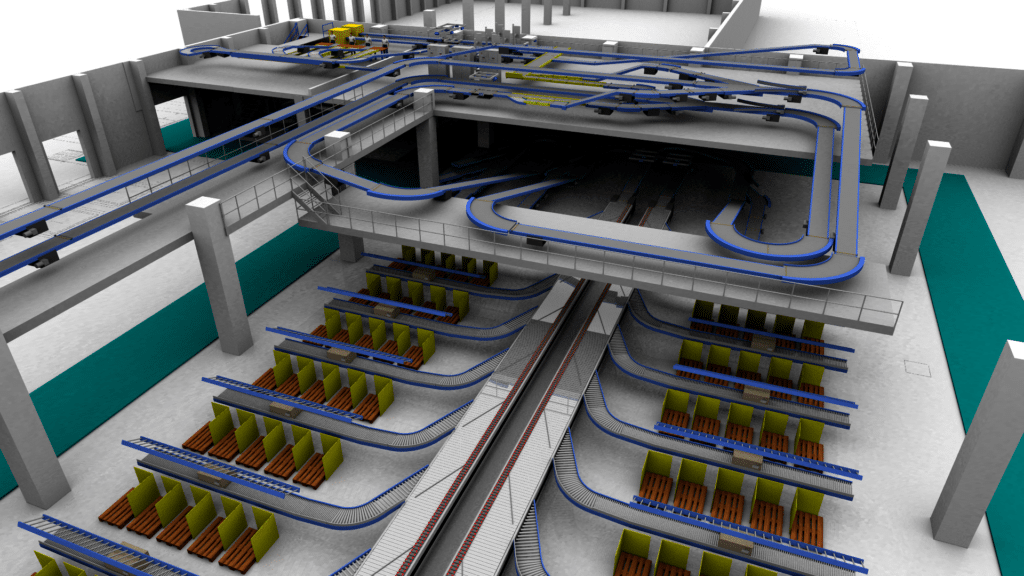
Model of a conveyor system from Emulate3D
What defines a true digital twin?
There are a number of misconceptions surrounding the digital twin. From our project experience, we have identified five that are particularly common:
- “A 3D model is already a digital twin.” It is only when linked to data that the model becomes dynamic. A 3D visualisation, for example using NVIDIA Omniverse, complements a digital twin but does not replace it.
- “More data automatically means better results.” It is the quality of the relevant data that matters, not the quantity.
- “The digital twin is an IT project.” Production, logistics and operations must be involved from the outset.
- “A model is created once.” A digital twin requires ongoing maintenance to ensure it remains consistent with the real-world plant.
- “Real-time is always required.” How often data needs to be updated depends on the specific use case.
What are the prerequisites for a digital twin, and what are its limitations?
The benefits of a digital twin depend directly on data quality and integration.
Technically, these are primarily data quality and data availability, interfaces between IT and OT, the modelling effort, the real-time capability of complex systems, and the maintenance and synchronisation of the model.
Organisationally, interdisciplinary collaboration, acceptance within operations, the development of expertise and clear responsibilities are required. And the effort involved must remain economically viable.
A digital twin does not replace experts. It supports well-informed decisions.
We explain in detail which technical components are required in our FAQ.
How does SimPlan support the development of a digital twin?
Many digital twins begin with a simulation model from the planning stage. If this model is structured correctly from the outset, it can later be reused for virtual commissioning and as an operational model during ongoing operations. To achieve this, SimPlan combines methodological expertise, project experience dating back to 1992 and experience with standard simulation tools.
This is how a digital twin is created with SimPlan:
- Provide data: You supply the existing data, for example as a database export or from SAP.
- Pre-process and transform: We filter, link, format and sort the data, and check it for consistency.
- Identifying rules: Using data mining techniques, we reveal rules and hidden correlations in your processes, such as scheduling rules.
- Automation: Algorithms systematically identify these rules, so that the model does not have to be manually adjusted every time new data is introduced.
- Generating insights: Results are visualised and discussed together with your team.
- Digital twin: The model maps your production or logistics using up-to-date data and is ready for use in scenarios and planning decisions.
- Optimising and reviewing: You implement measures in production and use new data to check whether they have been effective. In this way, the digital twin becomes part of the continuous improvement process (CIP).
On request, the digital twin can be equipped with a user interface that allows planners and key users to operate it themselves without any simulation expertise.
Project example: aluminium industry – digital twin of plant logistics
- Initial situation: A plant in the aluminium industry is supplied via a push system. The aim was to analyse the logistics between the machines and the utilisation of the warehouses.
- Implementation: SimPlan modelled the entire plant using real data from SAP. Logistics control can be defined via rules set by the customer themselves. Key users can utilise the model without additional licences (AnyLogic).
- Result: Changes to the logistics rules of the real-world system can be tested in advance using the model, as can overloads and production schedules. Various expansion scenarios were compared against one another in terms of their logistical capacity utilisation.
Project example: consumer goods industry – digital twin as a planning tool for non-simulators
- Background: A manufacturer in the consumer goods industry wanted to review and analyse production plans based on current key figures and system parameters from SAP.
- Implementation: SimPlan analysed and documented workflows and scheduling rules, set up a real-data import with consistency checks, and equipped the model with a user interface. It maps detailed production and work plans, schedules plant and staff pools, displays the load at runtime, and evaluates bottlenecks.
- Result: The client has independently put the tool into operation in their real production environment. It supports order planning there.
Both examples show that a digital twin does not necessarily have to rely on real-time sensor data. In both cases, up-to-date data from SAP forms the basis.
Would you like to know whether an existing simulation model can be expanded into a digital twin? Talk to our simulation experts about your specific use case.
Frequently Asked Questions
Does every digital twin require real-time data?
No. How up-to-date the data needs to be depends on the specific application. To test the daily programme, a data snapshot taken before the start of production is sufficient. Real-time data is primarily required for monitoring and early-warning systems during ongoing operations.
Is a 3D model or visualisation in itself a digital twin?
No. A 3D model shows what a plant looks like. It only becomes a digital twin when it is linked to operational data and a simulation model replicates the plant’s behaviour.
Can an existing simulation model become a digital twin?
Yes, if it is linked to real operational data, such as current order statuses, cycle times, set-up times and availability figures. Models that were structured from the outset during the planning phase are generally easier to reuse for this purpose.
What data does a digital twin need?
That depends on the specific question being addressed. Typical sources include PLCs, MES, ERP, WMS, as well as sensors and IoT devices. More important than the quantity is the quality of the data relevant to the decision in question.
Can staff without simulation expertise also use a digital twin?
Yes. With a suitable user interface, planners and key users can utilise the digital twin themselves, for example to review production plans or adjust logistics rules. The modelling itself remains the responsibility of simulation experts.