


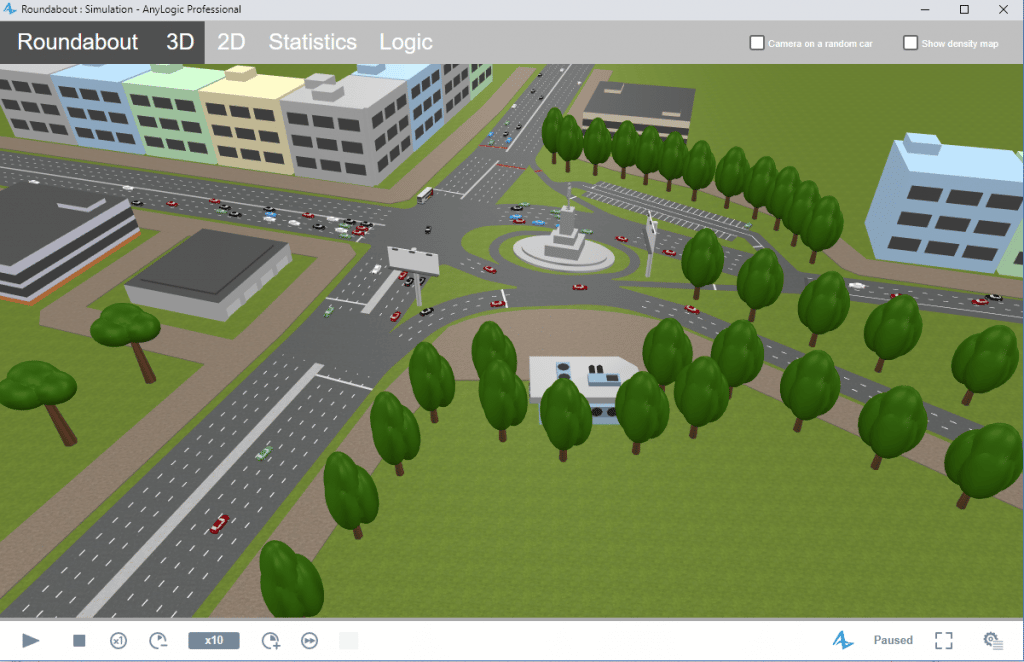
Traffic simulation: identifying bottlenecks, planning capacity, saving costs
Junctions, factory sites, terminals or entire local transport networks: traffic is becoming increasingly complex. Errors often only become apparent once operations are already underway, by which point any changes become costly. That is why it is worth testing traffic concepts digitally in advance, rather than waiting to test them in real-world operations.
Simulation digitally models real-world transport systems. This allows you to see how different scenarios affect throughput, waiting times, capacity and costs. As a result, you have reliable figures to inform your decisions, rather than relying solely on experience and assumptions.
Your benefits at a glance
- Optimisation of traffic flows: Identify bottlenecks and waiting times at an early stage and improve processes in a targeted manner.
- Capacity planning: Scale roads, terminals, charging infrastructure or fleets to match actual demand.
- Cost reduction: Identify planning errors before construction or implementation, rather than having to rectify them later at great expense.
- Risk minimisation: Run through critical scenarios such as peak times, disruptions or failures in advance.
- Transparent basis for decision-making: Present results in a visual and comprehensible way for all stakeholders.
- Data-driven planning: Use real operational data instead of relying on estimates.
- Preparing for change: Assess the impact of electrification, new regulations or growing volumes at an early stage.
Typical areas of application
- Factory and industrial transport: Forklift trucks, lorries and rail transport on factory premises, in logistics centres, ports and at airports
- Road traffic and urban planning: Junctions, traffic light sequences and traffic flows in cities and local authorities
- Public transport: Timetable and fleet planning for buses and trams, routes and stop layouts
- Electrification of vehicle fleets: Assessing range, charging infrastructure and powertrain mix prior to investment
- New infrastructure: Testing the capacity of terminals, railway stations and transhipment points before construction begins
- Delivery and supply traffic: Analysing lorries and delivery traffic at factories and distribution centres
- Emergency and exceptional scenarios: Assessing the impact of disruptions, closures or peak times in the transport network
Target groups: Who can benefit from transport simulation
Transport simulation can be applied across all sectors. Our target groups include, amongst others:
- Manufacturing and logistics companies across all sectors with their own factory or operational transport
- Local authorities, cities and transport operators planning or adapting roads and local transport networks
- Operators of terminals, ports and airports
- Consultancy firms specialising in transport, urban and industrial planning
- Facility management and infrastructure managers
Real-world examples
Two of our case studies illustrate how traffic simulation is used in specific projects:
Freight yard simulation: Prior to the construction of a new freight yard with a container terminal, SimPlan used simulation to test whether the planned operational concepts could reliably handle the required volumes. The result: bottlenecks were identified at an early stage, and customer requirements were finalised before costly adjustments would have become necessary during ongoing operations.
Digital twin of the Hanau tram network: To support the conversion of the bus fleet to alternative propulsion systems, SimPlan worked with Hanauer Straßenbahn GmbH to build a digital replica of the route network. This revealed, even before the investment was made, that a mixed fleet of battery-powered and fuel-cell buses would save around 22 per cent on energy and maintenance costs whilst maintaining the same fleet size.
Related services
Traffic simulation complements other services in our portfolio, such as pedestrian flow simulation for pedestrian and visitor flows, or material flow simulation for internal transport and warehouse systems.